What Is Office Cleanout? Massachusetts Business Guide 2026
- Joe Lusso
- 12 minutes ago
- 9 min read

Most Massachusetts business owners think office cleanouts are just hauling trash to a dumpster. The reality is far more complex. An office cleanout involves sorting, planning, legal compliance, and efficient execution, especially in Massachusetts where landlord obligations and waste disposal rules add layers of responsibility. Whether you’re managing a lease turnover, downsizing, or renovating, understanding the full process protects you from legal trouble, wasted time, and unnecessary costs. This guide walks you through every critical step, Massachusetts-specific requirement, and efficiency strategy you need to execute a successful office cleanout.
Table of Contents
Key Takeaways
Point | Details |
Office cleanout is a process | It involves assessment, sorting, scheduling, cleaning, and final checks—not just junk removal. |
Massachusetts laws apply | Legal requirements shape how tenant property and hazardous waste are handled during cleanouts. |
Sustainability matters | Proper recycling and donation reduce costs and environmental impact for your business. |
Careful planning minimizes disruption | A phased schedule and good workflow keep your business running during the cleanout. |
Understanding office cleanout: More than just junk removal
An office cleanout is a comprehensive service that goes far beyond basic trash hauling. It’s the systematic process of clearing, sorting, and disposing of all contents from a commercial space, preparing it for new occupancy or renovation. Unlike simple junk removal where you point at items and they disappear, office cleanouts require strategic planning, inventory management, and compliance with property agreements.
The difference matters for your bottom line. Basic junk removal handles obvious waste. Full decommissioning restores a space to original lease specifications, including repairs and deep cleaning. Office cleanout sits in the middle, focusing on complete content removal while addressing disposal obligations and business continuity.
Common scenarios requiring office cleanouts include:
End of lease transitions when tenants vacate
Company downsizing or relocation projects
Property acquisitions requiring space preparation
Renovation projects needing complete space clearing
Bankruptcy or business closure situations
Property managers and business owners share the same goal: minimize vacancy periods and align cleanouts with tight turnover timelines. Every day a commercial space sits empty costs money. The core process steps include assessment, sorting, scheduling, removal, cleaning, and verification, each designed to move efficiently while protecting legal interests.
“The cleanout process directly impacts how quickly you can re-lease or repurpose commercial space. Poor planning extends vacancy and increases holding costs.”
Understanding these distinctions helps you choose the right service level and set realistic timelines. For detailed workflows, explore our guide on office cleanout steps and commercial cleanout tips. Strategic approaches to organizing commercial cleanouts can cut your project timeline significantly.
The step-by-step office cleanout process
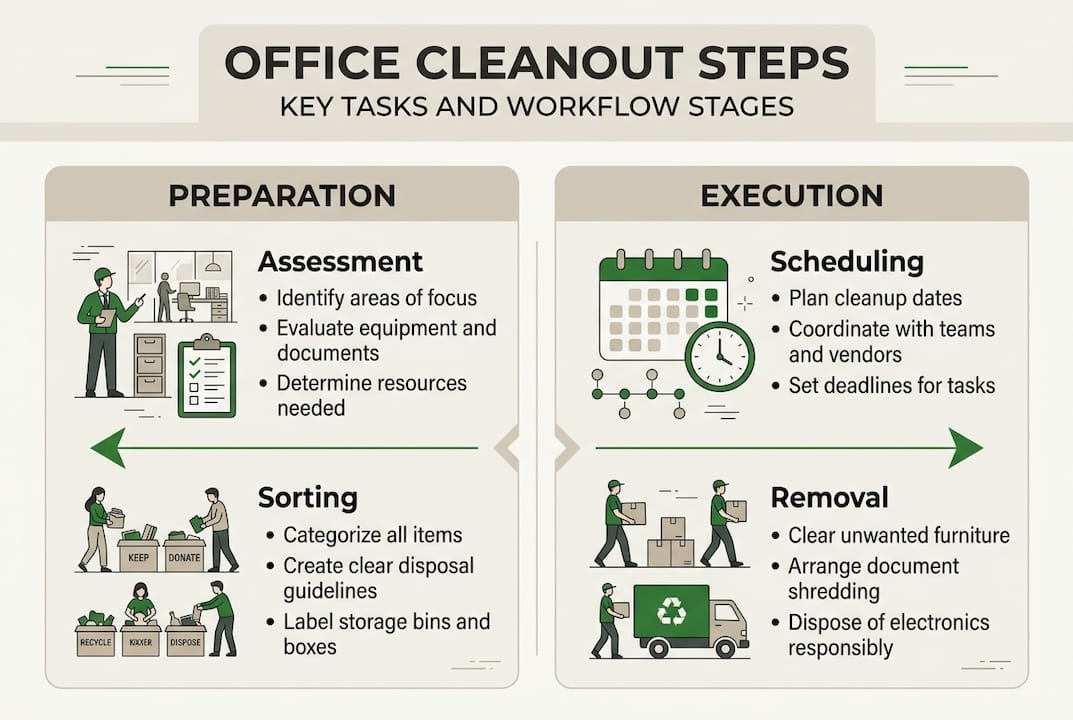
Now that you understand the big picture, let’s break down the office cleanout into clear, actionable steps. The recommended flow is assessment, organizing items, scheduling, removal, cleaning, and walkthrough verification, creating a systematic approach that prevents costly mistakes.
The six core stages:
Assessment and inventory: Walk the entire space, documenting all items, noting hazardous materials, and identifying items requiring special handling like electronics or confidential documents.
Sorting and categorization: Use the Four-Box Method to separate everything into keep, donate, recycle, and dispose categories. This prevents valuable items from ending up in landfills.
Scheduling and phasing: Plan removal in stages that minimize business disruption. Coordinate with building management for loading dock access and elevator reservations.
Removal execution: Systematically clear items according to your sorting plan, starting with large furniture and equipment, then moving to smaller items and debris.
Deep cleaning: Once empty, clean floors, walls, and fixtures to lease-ready condition. This step often reveals damage requiring repair.
Final verification: Conduct a walkthrough with property management or the new tenant to confirm the space meets agreed specifications.
Cleanout Stage | Typical Duration | Key Considerations |
Assessment | 2-4 hours | Document everything, photograph condition |
Sorting | 1-2 days | Separate hazmat, e-waste, confidential materials |
Scheduling | Varies | Coordinate with building, minimize disruption |
Removal | 1-3 days | Depends on volume and access constraints |
Cleaning | 1-2 days | May reveal needed repairs |
Verification | 1-2 hours | Get sign-off from stakeholders |
E-waste and sensitive documents demand extra attention. Massachusetts requires proper archival boxes for packing and secure destruction of confidential materials. Electronics contain valuable metals and hazardous components that must be recycled through certified facilities, never mixed with regular trash.
Scheduling phases around business operations is critical. If you’re downsizing rather than vacating completely, segment the cleanout so departments can continue working. Centralize waste collection points to streamline removal and reduce trips through active work areas.

Pro Tip: Create a detailed floor plan marking item locations and disposal categories. This visual reference keeps crews efficient and ensures nothing gets overlooked. Share it with your removal team before they arrive.
For comprehensive workflows, review our efficient office cleanout strategies and learn about commercial junk types you’ll encounter. Following commercial cleanout best practices prevents common pitfalls that extend timelines.
Navigating Massachusetts legal requirements during office cleanout
Beyond logistics, Massachusetts-specific rules are critical. Let’s look at the legal checkpoints you can’t skip. MA landlords must inventory, store, and properly notify tenants about abandoned property; bulk waste disposal may carry fees and city-specific rules; e-waste and hazmat must be separated.
Abandoned tenant property obligations:
Massachusetts law protects tenant property rights even after lease termination. Landlords cannot simply discard items left behind. You must inventory all abandoned property, store it securely, and provide written notice to the former tenant with access instructions. The storage period varies based on lease terms and property value, but typically ranges from 30 to 90 days.
Arbitrary move-out fees are prohibited unless explicitly stated in your lease agreement. Review your lease carefully before charging tenants for cleanout costs. If the lease is silent on removal fees, you likely cannot impose them retroactively.
Bulk and hazardous waste disposal:
Massachusetts municipalities enforce strict bulk waste rules. Many require advance scheduling, charge per-item fees, and prohibit certain materials from regular collection. Electronics, appliances containing refrigerants, and hazardous materials like paint or chemicals require separate disposal through approved facilities.
Material Type | Massachusetts Requirement | Typical Cost |
Electronics | Certified e-waste recycler | $10-50 per item |
Furniture | Bulk pickup or donation | $25-100 per item |
Confidential documents | Secure shredding service | $50-200 per box |
Hazardous materials | Approved hazmat facility | Varies by type |
Construction debris | Licensed disposal site | $75-150 per ton |
Key compliance points:
Never mix hazardous waste with regular trash
Obtain disposal receipts for audit trails
Verify vendor licenses and insurance coverage
Document all abandoned property with photos
Provide proper tenant notification in writing
“Massachusetts landlords face significant liability for improper disposal or premature discarding of tenant property. Documentation protects you from legal claims.”
For related guidance, explore our resources on MA storage unit cleanout regulations, storage unit cleanout laws, and property cleanout rules. Our landlord turnover cleanouts guide addresses common compliance questions, while facility cleanout steps cover larger commercial projects.
Best practices for responsible disposal and sustainability
Alongside legal compliance, sustainable disposal methods are both smart for the environment and for your business. Responsibly disposing of e-waste, hazardous materials, and recycling are best practices emphasized in commercial cleanouts.
Material separation is the foundation of sustainable cleanouts. Create distinct collection areas for electronics, paper products, metal furniture, wood items, plastics, and general waste. This upfront sorting dramatically increases recycling rates and often reduces disposal costs since recycling is frequently cheaper than landfill fees.
Sustainable disposal strategies:
Partner with local nonprofits for furniture and equipment donations
Use certified e-waste recyclers who provide disposal certificates
Separate metals for scrap recycling value recovery
Shred and recycle paper rather than landfilling
Identify reusable items for resale or internal redeployment
The financial benefits surprise many business owners. Donated items may qualify for tax deductions. Scrap metal generates revenue rather than costs. Recycling programs often charge less than trash hauling. A well-executed sustainable cleanout can actually reduce your total project cost while demonstrating corporate responsibility.
Electronics require special attention due to data security and environmental concerns. Hard drives must be professionally wiped or destroyed before recycling. Monitors, computers, and printers contain valuable materials but also toxic components. Massachusetts prohibits electronics in regular trash, making certified recycling mandatory.
Pro Tip: Request disposal certificates from all recycling and waste vendors. These documents prove compliance if questions arise later and support sustainability reporting for corporate initiatives.
For practical implementation, review our guide on commercial junk recycling and learn how to create a streamlined cleanout process that prioritizes sustainability without sacrificing efficiency.
Scheduling, workflow, and minimizing business disruption
Successful cleanouts aren’t just about removal. They hinge on a well-planned schedule and smooth workflow. Coordinating cleanouts with turnover periods and using centralized waste collection can reduce vacancy times and disruptions.
Phased scheduling protects ongoing operations. If you’re downsizing rather than vacating, segment the cleanout by department or floor. Complete one section fully before moving to the next. This approach maintains business continuity and prevents the chaos of simultaneous work across the entire facility.
Workflow optimization strategies:
Establish centralized collection zones: Designate specific areas for sorted materials rather than scattering items throughout the space. This reduces handling time and keeps pathways clear.
Coordinate vendor schedules: Align removal crews, cleaning services, and repair contractors to work sequentially, not simultaneously. Overlapping trades create bottlenecks and safety hazards.
Communicate with building management: Reserve loading docks, elevators, and parking well in advance. Confirm access hours and any restrictions on noise or equipment.
Plan for contingencies: Build buffer time into your schedule for unexpected discoveries like hidden damage, additional items, or access complications.
Document everything: Photograph spaces before, during, and after cleanout. This protects against disputes and provides proof of condition.
Timing matters significantly. Schedule intensive removal work during off-hours or weekends if the building remains occupied. Early morning or evening slots minimize elevator conflicts and reduce impact on neighboring tenants. For complete vacancies, weekday scheduling often provides better vendor availability and lower rates.
Pro Tip: Create a detailed project timeline with specific milestones and share it with all stakeholders. Include contact information for every vendor and decision-maker. This single document becomes your command center for the entire project.
Labor coordination prevents costly delays. Assign clear roles to internal staff, removal crews, and specialty contractors. One person should serve as the on-site coordinator with authority to make decisions and resolve issues immediately. Waiting for approvals extends timelines and increases costs.
For advanced planning techniques, explore our office cleanout workflow strategies and cleanout scheduling tips. Additional insights on smart packing tips apply to office moves and cleanouts alike.
Need professional office cleanout in Massachusetts?
If your next step is hands-on help, Massachusetts experts can simplify and expedite the process for you. Professional cleanout services handle every aspect we’ve covered: legal compliance, sustainable disposal, efficient scheduling, and complete execution. You focus on your business while experienced crews manage the details.

Junk Dispatch specializes in commercial office cleanouts across Massachusetts, offering same-day service, transparent pricing, and eco-conscious disposal. Our insured crews understand Massachusetts regulations and work efficiently to minimize your vacancy period. We handle everything from initial assessment through final verification, providing the documentation you need for property management and compliance records.
Whether you’re in Reading managing a lease turnover, coordinating an Essex County office renovation, or need commercial demolition services, local expertise makes the difference. We know municipal disposal requirements, have established relationships with recycling facilities, and can navigate building management protocols efficiently. Free estimates and flexible scheduling ensure your project stays on budget and on timeline.
Frequently asked questions
How long does an office cleanout usually take in Massachusetts?
A standard office cleanout can take one day to a week, depending on the size and complexity. Scheduling cleanout phases to minimize disruption is a best practice. Larger projects needing phased scheduling will take longer.
What happens to abandoned tenant property during a Massachusetts office cleanout?
Landlords must inventory, store, and allow tenant access per MA law. You cannot charge arbitrary removal fees unless stated in the lease. Proper documentation protects you from legal claims.
How should businesses handle e-waste and hazardous materials?
Massachusetts requires proper separation and recycling or disposal of e-waste and hazardous materials, never with regular trash. Use certified recyclers who provide disposal certificates for compliance documentation.
Can office furniture or equipment be donated rather than discarded?
Yes, items in good condition can be donated. This reduces waste and may offer tax benefits. Partner with local nonprofits for efficient pickup and proper documentation.
What’s the best way to minimize downtime during an office cleanout?
Phased cleanout and workflow planning reduces disruption. Schedule during low-traffic times, coordinate labor carefully, and establish centralized collection zones to maintain business continuity throughout the process.
Recommended
Comments