Commercial debris removal guide: 50-75% diversion
- Joe Lusso
- Mar 29
- 8 min read


Massachusetts businesses face some of the toughest debris disposal rules in the country. Miss a sorting requirement or skip a manifest, and you’re looking at fines, project delays, or lost green certifications that took years to earn. Commercial debris removal here isn’t just about hauling stuff away. It’s a regulated, documented process with real financial and environmental stakes. This guide walks you through every step, from understanding state law to executing a compliant, eco-friendly cleanout that keeps your project on schedule and your business protected.
Table of Contents
Key Takeaways
Point | Details |
Legal compliance first | Understanding and following Massachusetts regulations is crucial for every business project. |
Plan before you haul | A detailed plan, including audits and partnerships, streamlines debris removal and minimizes risk. |
Step-by-step execution | A structured workflow ensures safe, efficient, and eco-friendly debris removal every time. |
Prove your results | Track outcomes and keep documentation to demonstrate compliance and sustainability gains. |
Professional help available | Licensed vendors like Junk Dispatch make compliance and sustainability effortless for businesses. |
Understanding Massachusetts commercial debris regulations
Before you move a single bin, you need to know what the state expects from you. Massachusetts has built one of the most aggressive waste diversion frameworks in the nation, and commercial operators are squarely in the crosshairs.
The commercial organics ban is a prime example. Food-generating businesses that produce more than 0.5 tons of organic waste per week must divert that material to composting or anaerobic digestion rather than sending it to a landfill. The results speak for themselves: 342,000 tons processed, 1,676 jobs created, and a 25.7% reduction in greenhouse gas emissions tied directly to this program. That’s not a minor policy footnote. That’s a measurable shift in how Massachusetts handles commercial waste.
Construction and demolition (C&D) debris falls under separate but equally strict rules. Certain materials, including asphalt, concrete, wood, and metals, must be separated and diverted from landfills wherever feasible. Municipal programs add another layer, with many cities and towns setting their own diversion targets on top of state minimums.
Here’s what you need to stay compliant:
Identify which waste streams your project generates (organics, C&D, hazardous, recyclables)
Confirm whether your business volume triggers the organics ban threshold
Check local municipal requirements in addition to MassDEP rules
Verify that your hauler is licensed and registered with the state
Keep records of all waste manifests and diversion documentation
Non-compliance isn’t just a paperwork problem. Fines can reach thousands of dollars per violation, and repeat offenders risk permit suspensions. Choosing eco-friendly debris removal from the start is far cheaper than fixing violations after the fact.
Commercial debris removal process: Tools, team, and planning
Once you understand your obligations, preparation becomes your biggest competitive advantage. A well-planned removal project moves faster, costs less, and hits diversion targets more reliably than one that’s improvised on the fly.
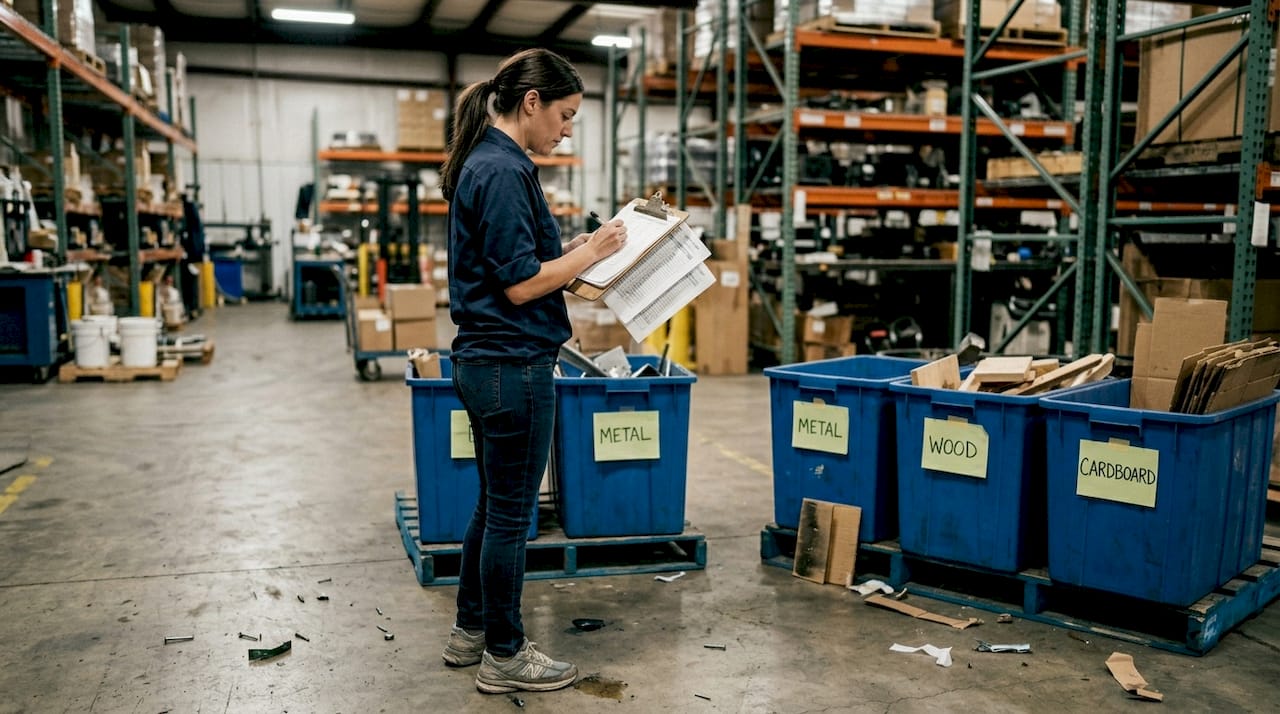
Start with a pre-project waste audit. Walk the site, catalog every material type you expect to generate, and estimate volumes. This step is the foundation of organizing commercial cleanouts effectively. Preconstruction audits and hauler partnerships are recognized best practices for achieving LEED certification and hitting the 50 to 75% diversion targets that Massachusetts projects aim for.
Here’s a comparison of two common approaches:
Approach | Diversion rate | Compliance risk | Cost efficiency |
Unplanned removal | 10-20% | High | Low |
Audited, planned removal | 50-75% | Low | High |
Your planning checklist should include:
Labeled, color-coded bins for each waste stream
Personal protective equipment (PPE) for all crew members
Waste tracking software or physical manifests
Multi-lingual signage if your crew speaks multiple languages
Confirmed contracts with licensed, insured haulers
A designated site supervisor responsible for compliance
Pro Tip: Don’t assume your hauler knows your project’s diversion goals. Put diversion targets in writing in your hauler contract. This protects you legally and keeps everyone accountable from day one.
For property managers juggling multiple sites, property management debris solutions can simplify coordination across locations and reduce the administrative burden of tracking compliance for each property separately.
Step-by-step guide: Executing commercial debris removal
With planning complete, execution is where projects succeed or fall apart. Follow this sequence to keep your removal fast, compliant, and low-waste.
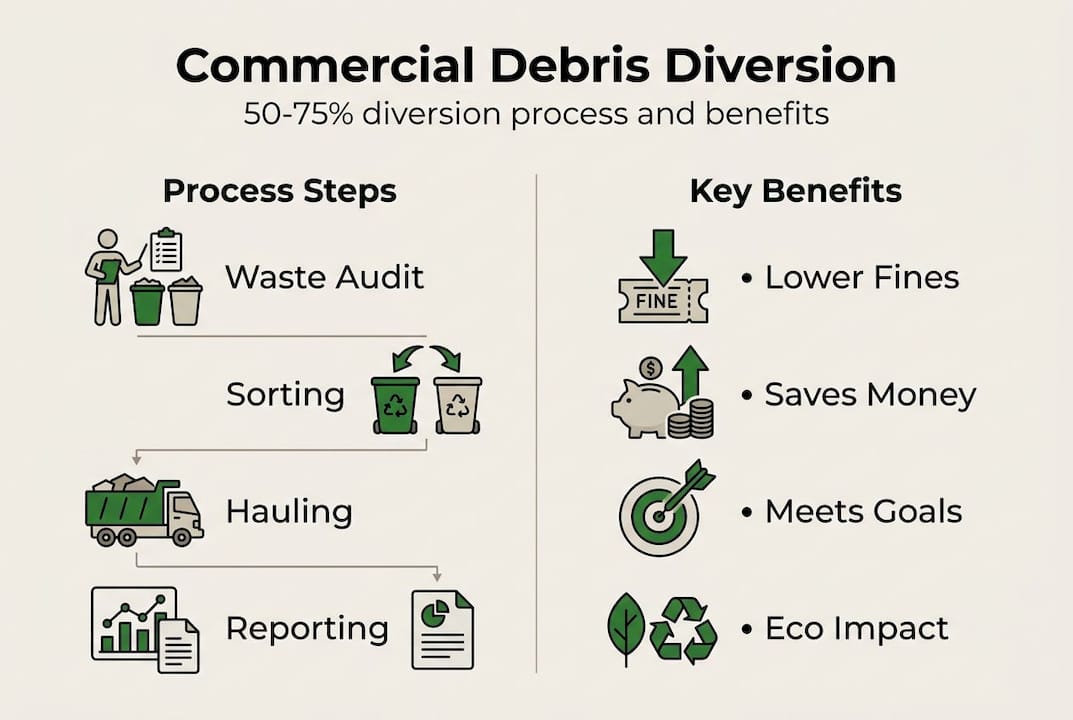
Conduct the pre-project audit — Catalog all materials, estimate volumes, and confirm diversion targets with your hauler.
Set up the site — Place labeled bins, post signage, brief the crew on sorting protocols, and confirm PPE is in use.
Begin onsite sorting — Separate recyclables, organics, C&D materials, and general waste at the source. Mixing streams at this stage is the single most common cause of failed diversion.
Load and document — As bins fill, record weights or volumes for each stream. Your hauler should provide manifests for every load.
Transport to approved facilities — Licensed haulers deliver each stream to the correct facility: composters, recyclers, C&D processors, or transfer stations.
Conduct a final site walkthrough — Confirm the site is clear, all documentation is collected, and no materials were left unsorted.
Compile your diversion report — Summarize total waste generated, diverted, and landfilled. This document is your proof of compliance.
Step | Purpose |
Pre-project audit | Identify materials and set targets |
Site setup | Prevent sorting errors from the start |
Onsite sorting | Maximize diversion at the source |
Load documentation | Create a compliance paper trail |
Approved transport | Meet state and LEED requirements |
Final walkthrough | Catch missed materials before closeout |
Diversion report | Prove compliance to regulators and clients |
Pro Tip: Schedule debris removal during off-peak business hours whenever possible. This reduces disruption to tenants or operations and gives your crew more space to sort accurately without pressure.
“Massachusetts projects using best practices often achieve 50-75% waste diversion, aligning with state and LEED targets.”
For contractors managing complex sites, a contractors’ workflow guide can help standardize these steps across multiple projects. And if you’re managing a full office or warehouse cleanout, efficient business cleanouts resources can help you scale the process without losing compliance oversight.
Ensuring compliance and maximizing sustainability
Executing the process correctly is only half the job. You also need to prove it. Regulators, clients, and certification bodies all want documentation, and the businesses that thrive in Massachusetts are the ones that treat compliance records as a strategic asset.
Here’s what strong compliance tracking looks like:
Waste manifests for every load, signed by the hauler and retained for at least three years
Diversion logs showing weights or volumes by material stream
Facility receipts from composters, recyclers, and processors confirming material acceptance
Digital tracking tools that aggregate data across multiple projects or sites
Photo documentation of sorted bins and site conditions before and after removal
The economic case for strong diversion programs is clear. Massachusetts businesses have collectively achieved 342,000+ tons diverted and generated an estimated $390 million in economic benefit through robust waste diversion. That’s not just an environmental win. It’s a business advantage.
Pro Tip: Share your diversion report with clients and tenants. Demonstrating measurable sustainability outcomes builds trust, supports green building certifications, and can be a genuine differentiator when competing for contracts.
Understanding the full scope of waste diversion benefits helps you frame debris removal not as a cost center but as a value-generating activity. Pairing that mindset with eco-friendly removal strategies keeps your operations lean and your compliance record clean.
Troubleshooting: Common mistakes and solutions
Even well-planned projects hit snags. Knowing the most common failure points lets you fix them before they become fines or delays.
Incorrect sorting at the source is the number one problem. When crew members mix recyclables with general waste or toss organics into a C&D bin, the entire load may be rejected at the processing facility. The fix is simple but requires consistency: clear signage, color-coded bins, and a brief daily crew huddle to reinforce protocols.
Missing or incomplete paperwork is the second most common issue. A missing manifest or unsigned receipt can invalidate your diversion claim entirely. Assign one person on every project to own documentation, and check records at the end of each day rather than scrambling at project closeout.
Other common mistakes include:
Using unlicensed haulers to cut costs, which voids compliance and exposes you to liability
Failing to update sorting protocols when project scope changes mid-job
Ignoring municipal rules that go beyond state minimums
Skipping the final site walkthrough and missing unsorted materials
LEED and Massachusetts initiatives both emphasize ongoing staff training and updated signage as the most effective tools for preventing compliance errors. A one-time training session isn’t enough. Build refresher check-ins into your project schedule.
“The businesses that avoid fines aren’t the ones with the most complex systems. They’re the ones with the most consistent habits.”
Pro Tip: Create a simple one-page compliance checklist specific to each project type (office cleanout, C&D site, warehouse). Laminate it and post it at the sorting station. Crew members are far more likely to follow a visible, simple guide than recall a training session from weeks ago.
Familiarizing your team with the full range of types of commercial junk helps prevent misclassification errors. And understanding the broader commercial removal role in MA gives your team context for why these rules exist and why following them matters.
Professional help for hassle-free debris removal
When compliance demands, tight timelines, or large-scale cleanouts push past what your internal team can handle, working with a local expert makes all the difference. Professional debris removal services bring regulatory knowledge, licensed crews, and eco-friendly disposal networks that most businesses simply can’t replicate in-house.
Junk Dispatch serves property managers, contractors, and business owners across Massachusetts with fast, insured, and eco-conscious debris removal. Whether you need Reading junk removal services, coverage across Essex County junk removal, or specialized appliance removal solutions, our team handles the heavy lifting and the compliance paperwork. We offer same-day scheduling, free estimates, and transparent pricing so you can focus on running your project while we handle the debris. Book online or call us today to get started.
Frequently asked questions
What types of commercial debris are regulated in Massachusetts?
Organic waste, construction and demolition debris, hazardous materials, and certain recyclables are all regulated under state law. Businesses generating over 0.5 tons/week of organic waste must divert it from landfills under the commercial organics ban.
Do I need a licensed hauler for commercial debris in Massachusetts?
Yes, most commercial debris removal requires a licensed and insured hauler, especially for C&D waste. Licensed hauler partnerships are also a core requirement for LEED certification and state compliance.
How can my business avoid debris removal fines?
Conduct pre-project audits, use approved haulers, train staff on sorting protocols, and document all diversion activity. Preconstruction waste audits and consistent staff training are the most effective preventive measures.
What are the sustainability benefits of commercial debris diversion?
Diverting debris reduces landfill pressure, cuts greenhouse gas emissions, and generates economic value. Massachusetts businesses have achieved 25.7% GHG reduction and $390 million in economic benefit through strong diversion programs.
Does a professional debris removal service handle compliance documentation?
Yes, professional services like Junk Dispatch manage waste manifests, facility receipts, and diversion records so your project stays compliant without adding administrative burden to your team.
Recommended
Comments