Residential decluttering: Streamline your Massachusetts home
- Joe Lusso
- 14 hours ago
- 9 min read

TL;DR:
Clutter takes up more space than homeowners realize and harms well-being despite being treatable. Effective decluttering reduces safety hazards, increases usable area, and enhances home value through strategic, eco-friendly methods. Consistent routines, professional support, and mindful disposal help maintain a clutter-free, functional living environment.
Clutter quietly takes over more space than most homeowners realize. Studies show that removing unused items from your home improves both its function and your day-to-day well-being, yet most people treat the whole process like a weekend chore rather than a strategy worth planning. Massachusetts homes, whether a colonial in Worcester or a Cape Cod in Gloucester, tend to accumulate years of stuff in basements, garages, and spare rooms. This guide cuts through the confusion, gives you a clear framework, and shows you exactly how to declutter with purpose, sustainability, and lasting results.
Table of Contents
Key Takeaways
Point | Details |
Decluttering is strategic | Residential decluttering is a structured process that goes beyond simple cleaning. |
Multiple methods exist | Room-by-room or category-focused approaches help homeowners tackle clutter their way. |
Workflow matters | Following a repeatable plan prevents overwhelm and produces lasting results. |
Eco-disposal is vital | Professional junk removal services in Massachusetts often prioritize eco-friendly disposal. |
Expert help accelerates success | Hiring professionals streamlines the process and ensures responsible item handling. |
Understanding residential decluttering
Residential decluttering is not the same as sweeping the kitchen floor or organizing your junk drawer. It goes deeper. Residential decluttering is the process of removing unwanted, unnecessary, or unused items from a home to reduce clutter and improve space functionality. That distinction matters because cleaning maintains a space, while decluttering transforms it.
Think about the last time you searched 20 minutes for something you own but could not find. That frustration is clutter in action. It is not just visual noise. It is a daily tax on your time, your focus, and your peace of mind.
“A home is not just a physical space. It is an environment that reflects and shapes how you feel every single day. When it is cluttered, everything feels harder.”
For Massachusetts homeowners, the benefits of a real declutter are concrete and measurable. Here is what intentional decluttering actually delivers:
More usable square footage — Rooms feel larger when storage areas are not packed with items you never touch.
Easier maintenance — Fewer items means faster cleaning, less dusting, and simpler organization.
Improved safety — Stacked boxes in hallways, basements, and garages create fire hazards and tripping risks.
Reduced stress — Research consistently links cluttered environments to elevated cortisol levels and lower mood.
Higher home value perception — Decluttered homes show better during appraisals and real estate showings.
There is also a strong overlap between smart decluttering and property management benefits, especially for landlords handling tenant turnover or homeowners preparing a rental unit. In both cases, a cleared, functional space means faster decisions and fewer headaches down the road.
Core methods for effective decluttering
With the basics in place, let us explore exactly how homeowners can approach decluttering because one method does not fit all. The good news is that several recognized methods exist, from the KonMari category-based system to straightforward room-by-room approaches, and each suits different types of households.
The KonMari method, developed by Marie Kondo, asks you to declutter by category rather than location. You gather every item in a single category (all clothing, all books, all kitchen tools) into one pile, then decide what “sparks joy.” This approach forces you to confront the true volume of what you own.
The room-by-room approach is more intuitive for busy Massachusetts families. You start in one room, finish it completely, then move to the next. Progress is visible and momentum builds naturally.
The ski slope method is less well-known but very effective. You start with the easiest, least emotional areas first (like a linen closet or utility room), build confidence and momentum, then tackle harder areas like attics or kids’ rooms. It is particularly useful if you feel overwhelmed at the idea of starting.
Here is a quick comparison of the three main frameworks:
Method | Best for | Starting point | Time commitment |
KonMari | Whole-home reset | By category | High (2 to 3 weeks) |
Room by room | Busy families | One room at a time | Moderate (weekends) |
Ski slope | First-time declutterers | Easiest area first | Low to moderate |
Once you pick a method, the workflow stays consistent regardless. Here is the standard sequence that works across all approaches:
Set your intention — Decide what you want the space to feel and function like when you are done.
Gather everything in one place — Pull items out so you can see the full scope of what you own.
Sort into three groups — Keep, donate, and toss. No “maybe” pile. Maybes become permanent residents.
Remove discards immediately — Bag them, box them, and get them out of the room the same day.
Organize what remains — Only now do you put things back, with a real system in place.
If you want a ready-made starting point, check out the decluttering checklist for Massachusetts homes for a room-by-room guide built specifically for local households. And if you are decluttering before moving, the sorting step becomes even more critical since every item you move costs time and money.
Pro Tip: Match your method to your schedule, not your ideal self. If you only have two-hour windows on Saturday mornings, pick the room-by-room or ski slope approach. The KonMari method requires longer, uninterrupted blocks of time that may not be realistic for working parents or busy professionals.
A step-by-step workflow for Massachusetts households
Once you decide on a method, making it actionable is the key to progress. This workflow helps Massachusetts residents get started without feeling buried under the weight of the whole project.
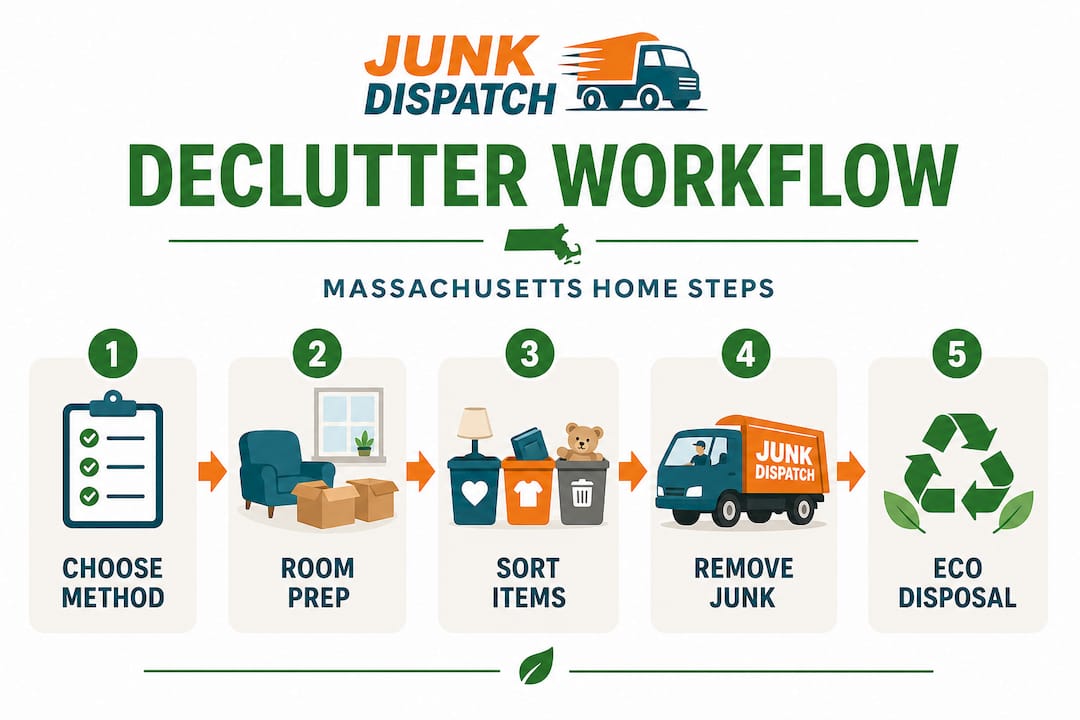
Decluttering is most successful when broken into stages with a repeatable workflow rather than treated as a single overwhelming task. That single insight changes everything about how you approach the process.
Here is the full workflow designed for a typical Massachusetts home:
Plan your timeline — Map out which rooms or categories you will tackle each week. Be specific. “I will do the garage on the first Saturday of each month until it is done” beats a vague “someday” plan every time.
Gather your supplies — Trash bags, labeling tape, boxes for donations, and a marker. Simple tools prevent delays mid-session.
Start with low-attachment areas — Bathrooms, laundry rooms, and kitchen pantries are great starting points because they hold fewer sentimental items and deliver fast wins.
Sort firmly — For every item, ask three questions: Have I used this in the last year? Would I buy it again today? Does it serve a purpose in my current life? If the answer to all three is no, it goes.
Designate donation drop-off and toss-out days — Do not let donation boxes sit in your hallway for weeks. Schedule a drop-off the same weekend you sort. For larger items like old furniture, appliances, or yard waste, schedule a junk removal pickup before you start so you have a deadline.
Tackle sentimental items last — Old letters, photos, childhood items. These are the hardest decisions and require emotional energy. Save them for when you have built momentum and confidence from completing easier areas.
Repeat the cycle — Once you finish a room, move to the next using the same process. Consistency is what makes the results stick.
Common pitfalls hit Massachusetts homeowners hard, especially in older homes with large attics and full basements. Decision fatigue is real. After sorting through 200 items, your judgment gets cloudy and “keep” starts winning every debate. Short sessions (90 minutes max) beat marathon days. If you hit a sentimental wall, box the items and revisit them in 30 days before making a final call.
For a detailed guide on managing larger load removals as part of your workflow, the downsizing declutter workflow offers practical advice that applies directly to Massachusetts homeowners clearing estate items or preparing for a move.

Pro Tip: Schedule your junk hauler before you start decluttering, not after. Knowing a truck is coming on Saturday at 10 a.m. creates a hard deadline that motivates sorting and prevents items from drifting back into storage.
Eco-friendly disposal: What happens to your unwanted items?
Having sorted and prepared items for removal, the final step is making responsible choices for disposal. This matters more than most people think. Massachusetts has some of the strongest environmental standards in the country, and residents who declutter with sustainability in mind contribute directly to reducing landfill pressure across the state.
Professional junk removal companies often support eco-friendly disposal, sorting items so that as much as possible is donated, recycled, or repurposed rather than sent to a landfill. That is a sharp contrast to simply renting a dumpster and tossing everything together.
Here is how different item types are typically handled through responsible disposal:
Item type | Preferred outcome | Common destination |
Clothing and textiles | Donation or textile recycling | Local shelters, thrift stores |
Furniture in good condition | Donation or resale | Habitat for Humanity ReStores |
Electronics | E-waste recycling | Certified MA recycling centers |
Appliances | Appliance recycling programs | Certified recyclers, retailers |
Yard waste and organics | Composting | Municipal compost sites |
Construction debris | Material salvage or recycling | Specialty recycling facilities |
True waste | Landfill (last resort) | Licensed disposal facilities |
Key advantages of choosing eco-conscious disposal:
Reduces landfill volume in Massachusetts communities already managing tight capacity.
Extends the life of usable goods by connecting them with families who need them.
Keeps hazardous materials like old paint, batteries, and electronics out of groundwater.
Supports local organizations through donated goods that fund community programs.
When you work with a local junk removal service, look for one that details its junk removal service types and explains how items are sorted and diverted from landfills. Transparency on that front is a good indicator of genuine eco-commitment, not just marketing language.
Why the right decluttering approach matters more than simply “getting rid of stuff”
Here is an opinion worth sitting with: most Massachusetts homeowners who declutter once end up right back where they started within 18 months. Not because they lack discipline, but because they treated decluttering as an event rather than a practice.
A one-day purge feels good. It creates visible results fast and gives you a sense of accomplishment. But without a system, a plan for ongoing disposal, and an honest look at how clutter enters your home in the first place, the same stuff creeps back in. This is the pattern we see repeatedly across all kinds of Massachusetts homes.
Decluttering success often depends on sequencing and having a repeatable workflow rather than treating it as a single overwhelming task. That is the difference between a client who calls us once and a homeowner who maintains a genuinely organized home year after year.
The most successful declutterers we encounter share one trait: they built a habit around removing things, not just storing them differently. They schedule seasonal reviews. They use a structured decluttering checklist to hold themselves accountable. And when large-item removal is needed, they do not let old furniture and appliances sit in limbo for months waiting for a “good time.”
There is also an emotional dimension that rarely gets enough attention. Sentimental clutter, things kept out of guilt, obligation, or vague future plans, takes a real psychological toll. Clients consistently report feeling lighter, less anxious, and more in control of their home environment once that category is handled thoughtfully. The relief is not about the stuff. It is about the decisions made and the clarity gained.
Eco-friendly disposal amplifies those long-term results. When you know an item went to a family that needed it or was properly recycled rather than dumped, the process feels complete. That sense of closure makes it easier to let go the next time around.
Take the next step: Professional help for Massachusetts decluttering
For Massachusetts homeowners ready to reclaim their space, here is how to make the process even easier and more sustainable.
Sorting is the hard work. Hauling is where professional help pays off immediately. Junk Dispatch provides fast, eco-friendly junk removal across Massachusetts, handling everything from old furniture and appliances to full garage cleanouts and yard waste. Our insured crews show up on time, sort for donation and recycling whenever possible, and handle the heavy lifting so you can stay focused on the decisions.
Whether you are tackling a full home declutter or just clearing out one problem area, having a reliable local team makes the difference between a project that stalls and one that gets finished. The Reading, MA junk removal pros at Junk Dispatch are ready to help you move from sorted to cleared in a single visit. And if you are in the North Shore area, our Essex County junk removal experts offer the same fast, eco-conscious service with same-day availability. Get a free estimate online and book in minutes.
Frequently asked questions
What is the first step in residential decluttering?
Begin by setting a realistic plan and tackling just one small area or category at a time. A staged, room-by-room approach with realistic timelines consistently outperforms trying to do everything at once.
How do I decide what to keep during decluttering?
Sort items into keep, donate, or toss groups, and ask if each item is truly used or valued. Many decluttering methods recommend these three categories specifically because the clear structure eliminates the mental drain of endless indecision.
Can professional junk removal services help with eco-friendly disposal?
Yes, many services in Massachusetts prioritize donation, recycling, and minimizing landfill waste. Junk removal services that support eco-friendly disposal sort items responsibly so usable goods find new homes instead of ending up in a landfill.
How often should I declutter my home?
Plan for a full declutter annually and smaller sessions seasonally to keep your home organized. Quarterly reviews of high-traffic areas like closets, kitchens, and garages prevent the slow buildup that eventually requires a major cleanout.
What if I get overwhelmed during the process?
Break down tasks, set short sessions, and consider hiring professionals for support. Decluttering feels far less overwhelming when you approach it in smaller, repeatable steps with a clear finish line for each session.
Recommended
Comments