How to manage construction debris efficiently in Massachusetts
- Joe Lusso
- 2 days ago
- 10 min read

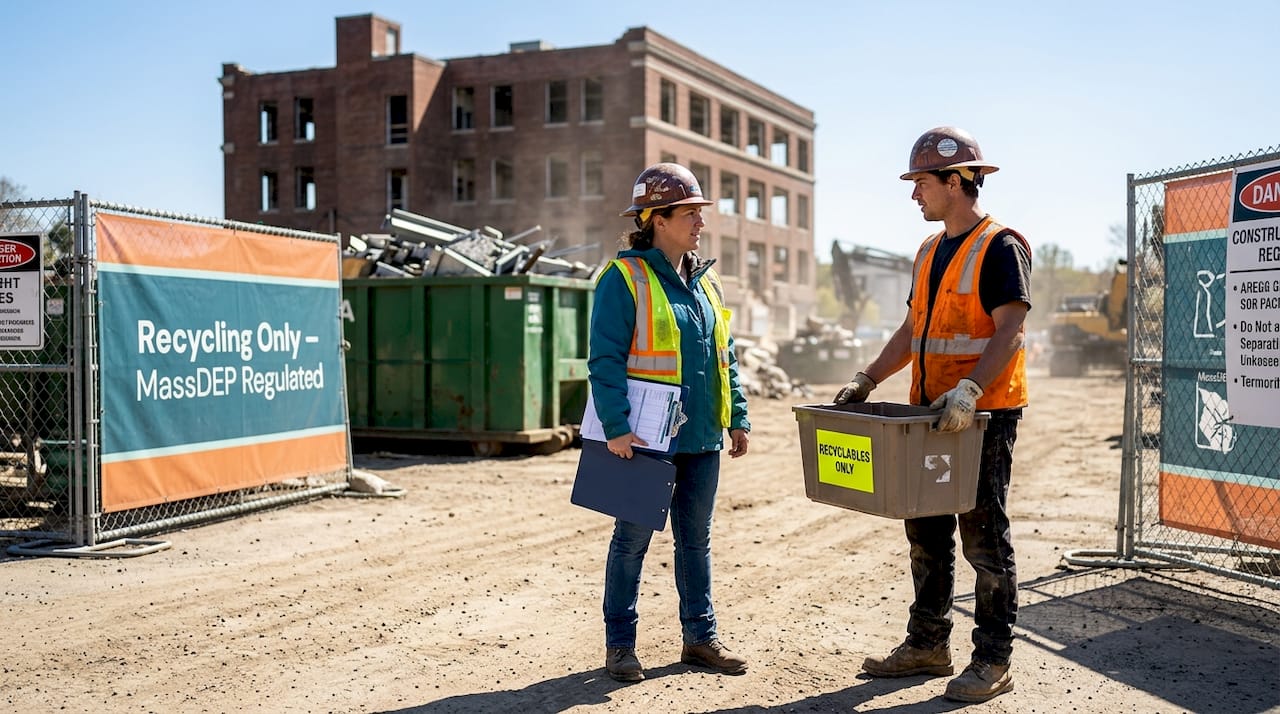
TL;DR:
Construction debris in Massachusetts must be properly sorted, recycled, and handled according to strict state regulations. Failure to comply can result in rejected loads, fines, and project delays; proactive site management and clear documentation are essential. Hiring professional services streamlines compliance and environmentally responsible disposal, ensuring efficient project completion.
Construction debris piling up on a job site in Massachusetts is more than an eyesore. It’s a legal liability. MassDEP’s waste bans prohibit the disposal or incineration of dozens of common construction materials, meaning homeowners and contractors who toss mixed loads into a dumpster without thinking could face rejected loads, hefty fines, and project delays. This guide walks you through every stage of debris management, from understanding state rules to setting up your site, sorting materials correctly, and documenting your compliance so your project stays clean, efficient, and on the right side of Massachusetts law.
Table of Contents
Key Takeaways
Point | Details |
Know your materials | Massachusetts bans many materials from landfill, so always check what’s allowed before your project. |
Plan your site setup | Equip your site with separate bins, signage, and a clear strategy for sorting and handling debris. |
Sort and recycle first | Prioritize reduction, salvage, and recycling over disposal to save money and stay legal. |
Stay vigilant on compliance | Keep records and train your team to avoid fines, illegal dumping, or debris rejection. |
Don’t hesitate to get expert help | Local professionals can handle the complex details and help you achieve eco-friendly results. |
Understand construction debris rules in Massachusetts
Before you start sorting debris, it’s crucial to understand Massachusetts’ strict regulations and how they apply to your project.
Construction and demolition (C&D) debris covers a wide range of solid waste generated during building, renovation, or teardown projects. Per MassDEP (Massachusetts Department of Environmental Protection), this category includes materials like concrete, wood, drywall, roofing shingles, metal, brick, and asphalt pavement. Knowing which of these are regulated is the first step to protecting yourself.
MassDEP’s waste bans prohibit disposal or incineration of many common construction materials at solid waste facilities. This means these items cannot be buried in a landfill or burned. They must be separated, recycled, or processed at an approved facility. There are specific construction debris types that fall under these bans, and being clear on each one matters before your first truckload leaves the site.
Commonly banned C&D materials in Massachusetts:
Asphalt pavement and shingles
Brick and masonry
Concrete and concrete products
Wood and clean dimensional lumber
Metals (ferrous and non-ferrous)
Cardboard and paper-based packaging
Gypsum wallboard (drywall)
Glass
Material | Accepted at landfill? | Required action |
Concrete | No | Recycle at approved processor |
Asphalt pavement | No | Recycle at asphalt plant |
Wood (clean) | No | Recycle or reuse |
Drywall | No | Recycle at gypsum processor |
Mixed C&D debris | Depends on composition | Separate streams before disposal |
Treated/contaminated wood | No | Special handling required |
Scrap metal | No | Recycler or scrap dealer |
Regular trash/garbage | Yes (with limits) | Dispose at permitted facility |
Understanding demolition debris regulations goes hand in hand with knowing which materials require extra handling, especially on larger projects involving multiple waste streams at once.
Pro Tip: Separate recyclable materials at the source, meaning before they ever enter a bin or truck. Mixing banned materials with regular trash is the most common reason loads get rejected at transfer stations, and a rejected load costs you extra time, money, and a return trip.
Non-compliance is not a small risk. Violations can lead to enforcement actions, financial penalties, and serious project delays. MassDEP actively monitors licensed facilities and can take action against contractors and property owners alike.
Plan ahead: Tools, materials, and site setup for debris management
With the regulations clear, it’s time to equip your site and staff for success.
Good debris management doesn’t start when the dumpster arrives. It starts in the planning phase, when you’re still deciding how many workers will be on site and how much material you expect to generate. Thinking through your site layout early saves time, reduces contamination, and sets clear expectations for everyone involved.
The EPA prioritizes source reduction first, then salvage and reuse, then recycling for sustainable materials management. That hierarchy should guide how you think about your site from day one. The less debris you generate, the less you have to manage.
Essential site setup items:
Clearly labeled containers for each material stream (concrete, wood, metal, general waste)
Color-coded or numbered bins to reduce confusion
Signage posted at each station listing what belongs and what doesn’t
Personal protective equipment (PPE) including gloves, steel-toed boots, and high-visibility vests
Tarp or containment barriers to prevent debris from spreading
Designated pathways to keep workers and equipment from mixing waste streams
Spill kits for liquid materials like adhesives or solvents
Item | Purpose | Notes |
Labeled bins (4+) | Sort debris by type | Use color coding for clarity |
Site signage | Educate all workers | Post at each station |
PPE kits | Worker safety | Required by OSHA standards |
Tarps/containment | Prevent cross-contamination | Especially important in wind |
Covered roll-off containers | Protect sorted loads | Prevents weather damage |
Waste log or tracking sheet | Record what leaves the site | Essential for compliance proof |
Understanding what falls into your commercial debris types can help you size your bins and plan your removal schedule more accurately, especially on longer projects.
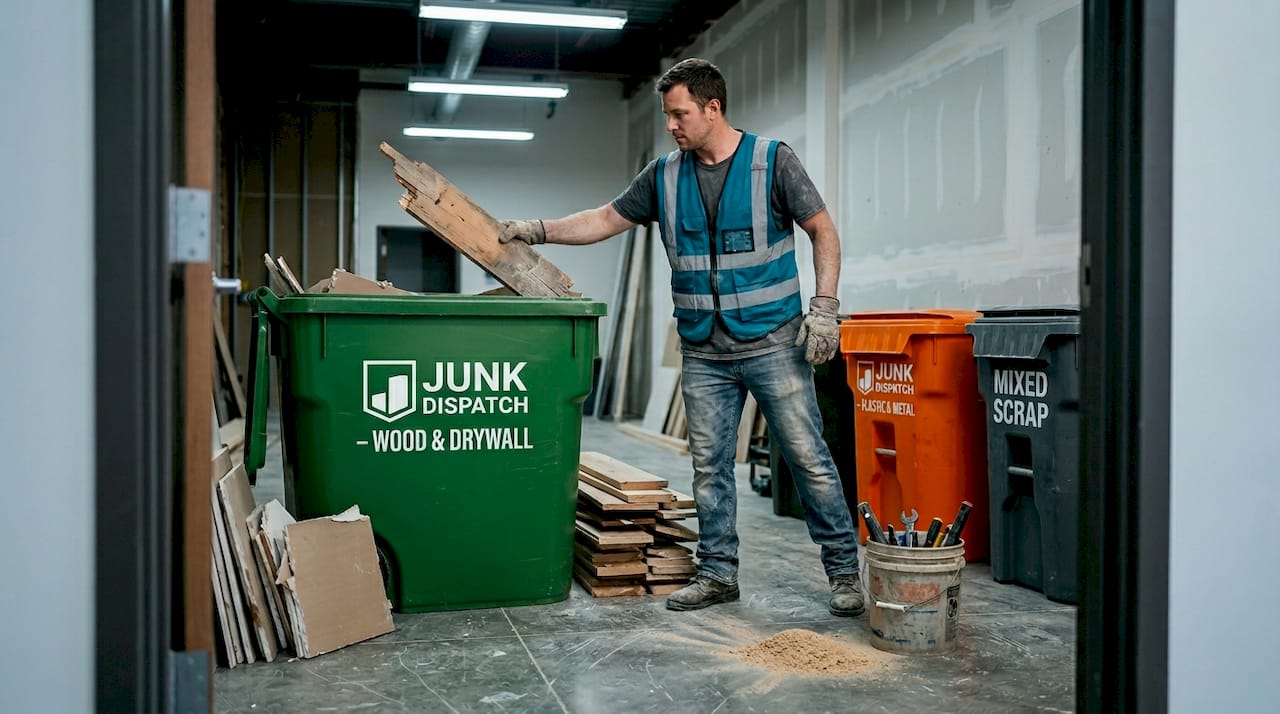
Pro Tip: Label every bin clearly and run a five-minute briefing with your crew at the start of the job. Workers who know exactly where each material goes are far less likely to throw everything into one container. Training is cheap. Cleaning up a contaminated load is not.
Source reduction deserves its own focus. Can you order materials more precisely to reduce excess? Can flooring, fixtures, or cabinets be salvaged before demolition begins? Every material that doesn’t enter the waste stream is one less item to sort, haul, and document.
Step-by-step: Sorting, recycling, and disposing of C&D debris
Now that your site is ready, follow these steps to manage debris efficiently and legally.
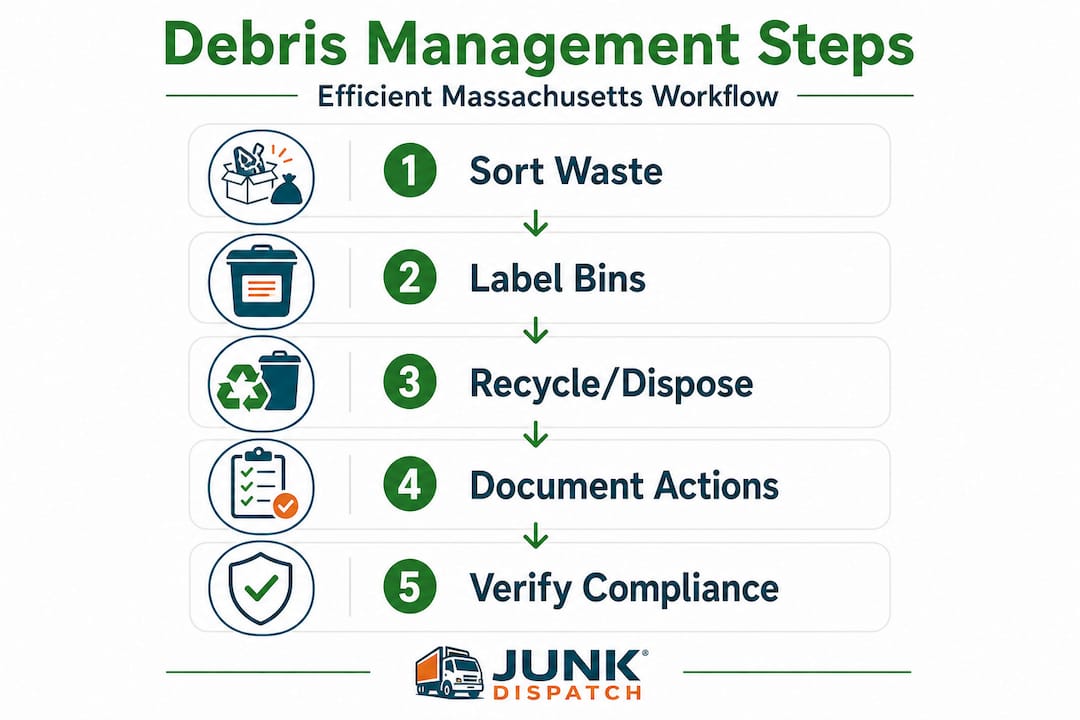
Managing C&D debris well requires a clear, repeatable process. Here’s a practical order of operations that keeps you compliant and maximizes the amount of material that gets recycled rather than discarded.
Practice source reduction first. Before any demolition starts, identify opportunities to limit how much waste is created. Order materials precisely, avoid over-purchasing, and salvage anything usable before teardown begins.
Separate materials at the point of generation. As workers remove materials, direct each type to its designated bin immediately. Don’t allow mixing at this stage.
Salvage and reuse before recycling. Doors, windows, cabinets, and fixtures in good condition can often be donated to organizations like Habitat for Humanity ReStore instead of being trashed.
Sort remaining materials for recycling. Concrete, wood, drywall, and metals should each go to approved processors in Massachusetts. Research your local licensed facilities before hauling anything off-site.
Handle special waste separately. Treated wood, asbestos-containing materials, and any contaminated debris require special handling. Contact MassDEP or a licensed hauler for guidance.
Dispose of true residual waste last. Only materials that genuinely cannot be salvaged, reused, or recycled should go to a permitted solid waste facility.
MassDEP requires that banned materials be diverted and handled under an approved compliance approach. This means your process should align with state expectations from start to finish, not just at the point of disposal.
The EPA recommends source reduction, salvage and reuse, and recycling as the preferred hierarchy. Treating this as your actual workflow rather than a checklist item protects both your project and the environment.
Common mistake: Mixing debris streams at the site might seem like a time-saver in the moment, but it almost always causes bigger problems downstream. A contaminated load at a transfer station can be rejected entirely, forcing you to transport everything back, re-sort it, and pay disposal fees twice. The cost of being careless far exceeds the cost of being careful.
Check your local disposal methods before hauling materials off-site so you know exactly where each type of debris is accepted. Also review these debris recycling tips and this sustainable disposal guide for best practices specific to Massachusetts.
Pro Tip: Keep all receipts, weight tickets, and documentation from recycling centers and transfer stations. If you’re ever audited or questioned about your disposal practices, this paper trail is your best protection.
Preventing illegal dumping and managing difficult scenarios
Even a well-planned site can encounter unexpected hurdles. Here’s how to ensure compliance through every stage and avoid costly mistakes.
Illegal dumping is a serious problem in Massachusetts and elsewhere. It refers to disposing of waste, including construction debris, on private or public land without authorization. On your site, this might mean a subcontractor dropping materials in an unapproved area, or a neighbor using your dumpster for their own waste. Either way, you could be held responsible.
Strategies to prevent illegal dumping on your site:
Secure your dumpsters with locks or lids when not in active use
Post visible signage stating the dumpster is for authorized use only
Fence or barricade the perimeter of active sites after work hours
Maintain a log of who removes debris and when
Educate all workers and subcontractors about dumping regulations and consequences
Report suspicious dumping to local authorities immediately
The EPA highlights accessible disposal options, outreach, collaboration, and enforcement as the most effective tools for preventing illegal dumping. That combination, making it easy to do the right thing while also making the consequences of the wrong thing very clear, works on any job site.
Warning: Contractors may face enforcement if C&D material streams are contaminated or not handled per compliance plans. Contaminated loads can be fully rejected at transfer stations, leaving you with the cost and responsibility of re-handling those materials from scratch.
Edge cases require extra care. If your project involves disaster debris, meaning materials from a flood, fire, or storm, the handling rules may differ from standard C&D waste. Contaminated materials from older buildings, particularly those containing asbestos or lead paint, require licensed abatement contractors and cannot be managed through normal debris channels.
Understanding the importance of debris removal goes beyond aesthetics. Debris left unmanaged creates safety hazards, attracts illegal dumping from others, and signals to regulators that site management is lacking. Clean sites stay compliant sites.
Verifying compliance and ensuring eco-friendly results
To complete your journey, make sure every action is properly documented and your efforts benefit both the environment and future projects.
Documenting your debris management process is not just good practice. In Massachusetts, it’s essential. MassDEP requires permitted facilities to submit annual compliance reports, and enforcement is active. That culture of accountability should extend to your own site records.
Compliance documentation checklist:
Record the types and estimated volumes of each material generated on-site.
Log dates and destinations for every load that leaves the site.
Collect and file receipts or weight tickets from recycling processors and transfer stations.
Document any special handling arrangements for hazardous or restricted materials.
Note any incidents, like a rejected load or an unauthorized dumping event, and how they were resolved.
Review your waste log at project end to identify what could be improved next time.
Documentation item | Why it matters | When to collect |
Weight tickets from recyclers | Proof of compliant disposal | Each trip |
Receipts from transfer stations | Legal protection | Each delivery |
Bin labels and photos | Evidence of separation | Throughout project |
Waste volume estimates | Planning and reporting tool | Start and end of project |
Incident reports | Shows corrective action | As needed |
Reviewing your process after every project is how good practices become second nature. If a particular material type kept ending up in the wrong bin, address that in your pre-job briefing next time. If a hauler’s route added time and cost, find a closer approved facility for the next job.
Connecting your eco-friendly debris solutions to your overall project reputation also matters. Clients, property managers, and general contractors in Massachusetts increasingly expect sustainable practices. Showing that your site is clean, compliant, and environmentally responsible builds trust and sets you apart from competitors who cut corners.
Why most construction debris plans fail—and the simple fix
With the basics covered, let’s step back and address the often-overlooked human factors that make or break real-world debris management.
Here’s what nobody talks about in the average debris management article: most failures aren’t caused by contractors who don’t care. They’re caused by contractors who assumed someone else was handling it.
A crew leader tells the newest worker to manage the bins. The newest worker has never heard of MassDEP’s waste bans. Mixed loads start piling up. By the time a supervisor notices, the damage is already done, and the load may be rejected.
When material streams are contaminated or mishandled, recycling rates fail and enforcement actions follow. This is exactly what happened in a documented MassDEP enforcement case in Brockton, where improper handling at a transfer station led to official penalties. What could have prevented it? Basic accountability, real-time supervision, and clearly defined responsibilities.
The best-organized sites we’ve seen don’t rely on elaborate systems. They rely on one person whose job it is to check the bins every day. Not weekly. Not at the end of the project. Daily. That person catches misplaced materials before they become a problem, reminds workers of the rules when shortcuts start creeping in, and keeps the waste log updated in real time.
The efficient removal guide covers the logistics side, but the human side is where compliance lives or dies.
Pro Tip: A five-minute daily site walk costs nothing and can prevent thousands of dollars in rejected loads, fines, and delays. Make it a non-negotiable part of your job site routine, and assign one person to own it every single day.
The fix is simple, but it requires intention. Decide upfront who is responsible for debris management. Give that person authority, tools, and training. Review the results daily, not just before the dumpster gets hauled away.
Get help with construction debris removal in Massachusetts
Whether your project is large or small, expert junk removal services can keep you on track and on the right side of the law.
Managing construction debris properly takes time, planning, and real knowledge of Massachusetts regulations. Not every homeowner or contractor has all three. That’s where Junk Dispatch comes in. We’re a local, insured junk removal team serving communities throughout Massachusetts, and we specialize in handling C&D debris quickly, responsibly, and in full compliance with state requirements.

From single-room renovations to full commercial teardowns, we sort, haul, and dispose of debris using eco-friendly methods that prioritize recycling and responsible processing. If you’re in Reading, MA or anywhere across Essex County, our crews are ready with same-day availability and transparent pricing. Need help with a more complex teardown? Our demolition debris specialists handle the heavy lifting so you can focus on the build. Get your free estimate online today and let us take debris management off your plate.
Frequently asked questions
What construction materials are banned from landfill in Massachusetts?
Materials like concrete, brick, and asphalt are banned from landfill disposal in Massachusetts and must be recycled or processed at approved facilities, along with wood, metal, and drywall.
Do I need different bins for each type of debris?
Yes, using separate containers for each recyclable type is essential because banned materials must stay uncontaminated and properly separated, or recycling centers may reject the entire load.
How can I prevent illegal dumping from happening on my property?
Maintain visible site boundaries, provide accessible and clearly labeled disposal options, and make sure everyone on-site understands the legal and environmental consequences, following what the EPA recommends for prevention.
Is it easier to hire a professional for construction debris removal?
Hiring a local junk removal service saves time, reduces compliance risk, and supports recycling efforts, especially on larger projects where sorting and hauling multiple material streams becomes complex and time-consuming.
Recommended
Comments