Massachusetts Junk Disposal Strategies for Homeowners in 2026
- Joe Lusso
- 13 minutes ago
- 9 min read

TL;DR:
Massachusetts enforces strict waste bans and municipal rules to manage junk disposal effectively and promote eco-friendly methods. Residents must categorize waste, follow city-specific collection procedures, and verify hauler licensing to ensure compliance and reduce landfill impact. Planning ahead for bulky, hazardous, and multi-item pickups, along with sorting into donation, recycling, and disposal, optimizes waste management and environmental sustainability.
Effective Massachusetts junk disposal strategies are defined by strict state waste bans, detailed municipal rules, and a growing push toward eco-friendly methods that keep materials out of landfills. Massachusetts banned textiles from landfills effective November 1, 2022, and that single regulation changed how every homeowner and renter in the state must think about clutter. Cities like Boston and towns like Shrewsbury have layered their own collection rules and hauler requirements on top of state law, making it harder to just “throw things out.” The good news is that once you understand the categories and the rules behind each one, disposal becomes a straightforward process rather than a guessing game.
1. Know the core Massachusetts junk disposal strategies before you start
Waste management in Massachusetts operates on a category system. The state, through the Massachusetts Department of Environmental Protection (MassDEP), assigns specific legal disposal routes to different types of junk. Treating all junk as one undifferentiated pile is the fastest way to get a missed pickup, a fine, or a rejected load at a transfer station.
The six categories every Massachusetts homeowner needs to know are:
Textiles and mattresses: Banned from landfills since 2022, these must go to textile recyclers or donation centers. Clean, dry clothing, footwear, bedding, curtains, and fabric scraps all qualify for donation or recycling through programs at retailers and municipal drop-off sites.
Appliances and electronics: Refrigerators, freezers, and CRT monitors require appointment-based special collection in Boston and similar programs elsewhere. Freon-containing appliances are treated as hazardous and cannot be left at the curb without preparation.
Bulky items: Furniture, large fixtures, and oversized household goods fall under bulk pickup programs with strict item limits and staging requirements.
Household hazardous waste: Batteries, paints, propane cylinders, and car fluids require dedicated collection events. Cambridge, for example, runs hazardous waste collection days with strict drop-off rules and resident-only access.
Vehicles: Junking a car in Massachusetts requires surrendering the Certificate of Title to the RMV within 10 days. The VIN must stay attached, and the vehicle cannot be re-registered after junking.
General recyclables: Paper, cardboard, glass, and plastics follow standard curbside recycling rules but must be clean and sorted correctly.
Pro Tip: Sort your junk into six labeled piles before you call anyone. This single step tells you exactly which disposal route each item needs and prevents costly mistakes.
2. Understand Boston’s special collection rules in detail

Boston’s special collection program is one of the most structured in the state, and missing its requirements means your items stay on the curb. The city limits special collections to 10 items per year, with a maximum of five items per appointment. That limit resets annually, so planning which items to schedule first matters.
Preparation rules are non-negotiable. Refrigerators and freezers must have all food removed and doors detached before pickup. Appliances containing Freon are treated as hazardous materials and require the appointment-based route rather than standard bulk pickup. Items must be staged outside by 6 a.m. on the pickup day, or after 5 p.m. the night before. If you need to cancel, it must happen before noon the day prior or you lose the appointment slot.
“Disposal starts with knowing city guidelines. Boston’s detailed special-collection rules emphasize preparing items correctly to guarantee pickup.” — Boston.gov Special Collection
For renters in multi-unit buildings, this matters even more. If your building’s private hauler does not follow compliant procedures, your items may not get collected at all. Knowing the rules protects you from being left with junk on your hands through no fault of your own.
3. Follow Shrewsbury’s 2026 private hauler regulations
Shrewsbury’s updated regulations represent a statewide trend worth watching. Under rules taking effect by December 31, 2026, private haulers must be permitted and required to verify that they use licensed Material Recovery Facilities. By January 1, 2027, those haulers must guarantee recycling access for residents in apartments and condos.
This matters for renters specifically. If you live in a multi-unit building in Shrewsbury or a town adopting similar rules, your landlord’s hauler must now prove they are sending recyclables to a licensed facility. You have the right to ask. Choosing a permitted hauler who verifies recycling facilities is not just good practice. It is increasingly a legal requirement.
For homeowners hiring private junk removal services anywhere in Massachusetts, the lesson is the same. Ask your hauler directly: Are you permitted? Which licensed Material Recovery Facility do you use? A reputable service answers both questions without hesitation.
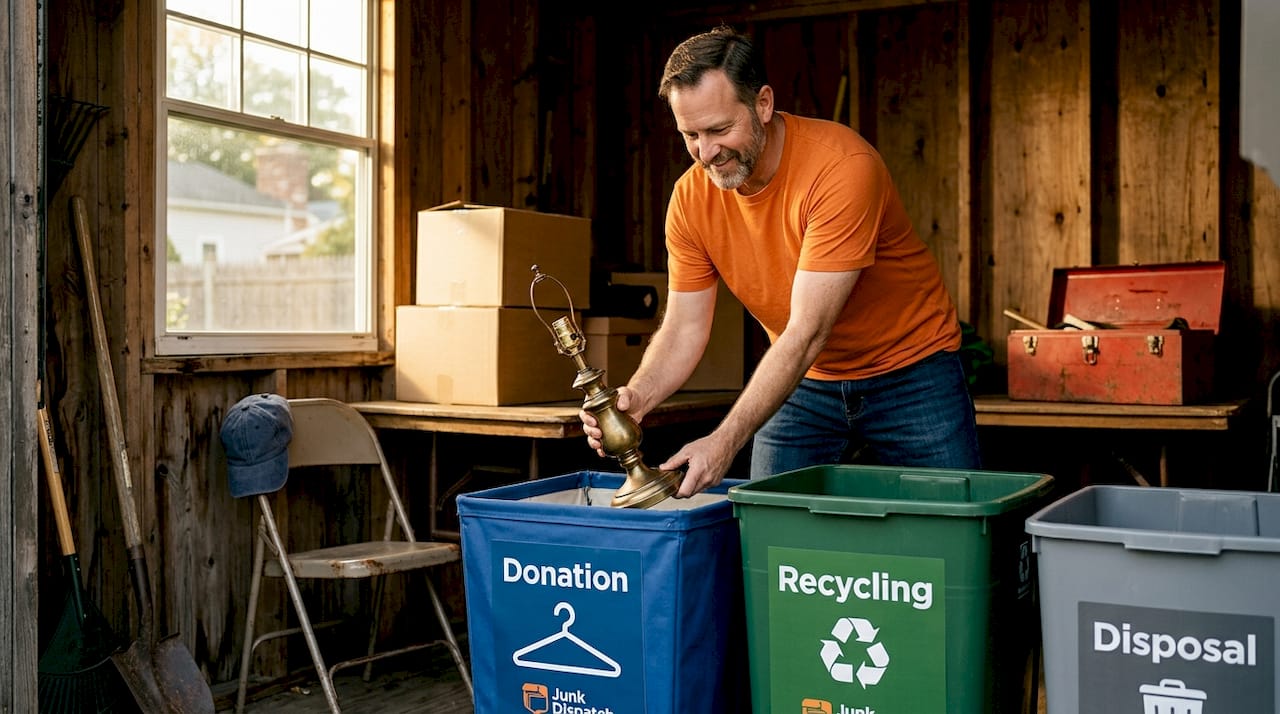
4. Sort junk into donation, recycling, and disposal piles
The three-pile method is the most practical framework for Massachusetts residents managing a cleanout. It aligns directly with state waste bans and reduces the volume of material that needs paid disposal.
Donate: Clothing, furniture in good condition, working electronics, and kitchenware can go to Goodwill, Habitat for Humanity ReStores, or local Buy Nothing groups. Donated items avoid landfill entirely and often get picked up for free.
Recycle: Textiles that cannot be donated, cardboard, metals, and clean plastics belong in the recycling stream. For sustainable disposal in Massachusetts, pairing curbside recycling with municipal drop-off programs covers most household materials.
Dispose: What remains after donation and recycling is the true disposal load. This is what you schedule for bulk pickup, transfer station drop-off, or professional junk removal. Reducing this pile through the first two steps cuts both cost and environmental impact.
Pro Tip: Take photos of items before donation or recycling. Some organizations provide tax receipts for donated goods, and documentation protects you if questions arise later.
5. Use household hazardous waste collection events
Household hazardous waste is the category most homeowners handle incorrectly, usually by putting it in the trash. That approach is both illegal and genuinely dangerous. Massachusetts municipalities run dedicated collection events throughout the year specifically to prevent this.
Cambridge’s hazardous waste collection events accept batteries, car fluids, propane cylinders, paints, and similar materials. Access is restricted to residents, and each event has a list of accepted and non-accepted items published in advance. Showing up without checking that list wastes a trip.
Most Massachusetts towns run at least one or two of these events per year. Check your town’s public works website in January to find dates for the full calendar year. Scheduling disposal of hazardous materials around these events is far cheaper than hiring a specialty hazmat hauler and keeps dangerous materials out of the waste stream entirely.
6. Compare municipal services, private haulers, and DIY transfer station drop-off
Choosing the right disposal method depends on what you have, how much of it there is, and how quickly you need it gone. Here is how the three main options compare for Massachusetts residents:
Method | Cost | Convenience | Compliance risk | Best for |
Municipal bulk pickup | Low to free | Moderate (scheduling required) | High if prep rules missed | Single large items, annual cleanouts |
Private licensed hauler | Moderate to high | High (they handle everything) | Low if hauler is permitted | Full cleanouts, mixed junk loads |
DIY transfer station | Low | Low (requires transport) | Moderate (bans apply) | Small loads, single material types |
Municipal services cost the least but carry the highest compliance risk because preparation rules are strict and item limits apply. Boston’s 10-item annual cap means a full garage cleanout cannot be handled through special collection alone.
Private haulers offer the most convenience and, when properly licensed, the best recycling outcomes. The tradeoff is cost. For a full home cleanout with mixed materials including appliances, furniture, and textiles, a licensed hauler is the most time-efficient and legally sound option. DIY transfer station drop-off works well for single-material loads like yard waste or clean wood, but residents must still comply with all active waste bans.
Pro Tip: Before hiring any private hauler, search the Massachusetts DEP website to confirm they hold a valid solid waste permit. An unlicensed hauler can leave you liable for illegal dumping even if you paid someone else to do the work.
7. Leverage eco-friendly disposal methods aligned with state law
Massachusetts waste bans are not just legal constraints. They are the architecture of the state’s recycling infrastructure. The phased waste bans starting in 1990, with textiles and mattresses added in 2022, pushed municipalities and haulers to build out recycling capacity that now benefits every resident.
For eco-friendly disposal in practice, this means three things. First, textiles go to certified recyclers or donation programs, not the trash. Second, mattresses go to mattress recycling programs, several of which operate statewide. Third, electronics go to e-waste collection events or retailer take-back programs run by Best Buy and Staples.
The environmental benefit compounds when you consider scale. A single household diverting textiles, electronics, and appliances from landfill over one year removes hundreds of pounds of material from the waste stream. Multiply that across a neighborhood and the impact on local landfill capacity is measurable.
8. Plan ahead for bulky item disposal
Bulky items, including sofas, mattresses, and large appliances, require more lead time than standard junk. Municipal programs have scheduling windows that can run two to four weeks out, especially in spring and fall when demand peaks. Waiting until the day before a move or renovation to schedule pickup almost always results in delays.
For furniture disposal in Massachusetts, the best approach is to identify bulky items at least three weeks before you need them gone. Schedule municipal pickup first. If the wait is too long or the item count exceeds program limits, book a private hauler for the overflow. This hybrid approach keeps costs down while meeting deadlines.
Property managers handling tenant turnover face this challenge repeatedly. The 2026 disposal guide for Massachusetts property managers covers this in detail, but the core rule applies to homeowners too: build disposal lead time into any renovation or move-out timeline.
Key takeaways
Effective junk disposal in Massachusetts requires sorting by category, following municipal prep rules, and choosing licensed haulers who verify recycling facilities.
Point | Details |
Sort before you dispose | Divide junk into donate, recycle, and dispose piles to comply with state waste bans. |
Know your city’s rules | Boston limits special collections to 10 items per year with strict preparation requirements. |
Verify your hauler | Ask for permit status and the name of the licensed Material Recovery Facility they use. |
Use hazardous waste events | Municipal collection days handle batteries, paints, and car fluids safely and at no cost. |
Plan bulky items early | Schedule municipal or private pickup three or more weeks in advance to avoid delays. |
What I’ve learned from watching Massachusetts residents navigate disposal rules
I have seen the same mistake repeated more than any other: homeowners assume that because they are paying for junk removal, compliance is someone else’s problem. It is not. If your hauler dumps illegally, the liability can trace back to you. That is not a hypothetical. It has happened.
The residents who handle disposal well share one habit. They spend 20 minutes researching their specific town’s rules before they touch a single item. That research tells them what requires an appointment, what has a fee, and what can be donated instead of disposed. Twenty minutes of reading saves hours of rescheduling and, in some cases, real money in fines.
The 2026 hauler regulations in Shrewsbury signal where the rest of Massachusetts is heading. Transparency about recycling destinations will become standard, not optional. Renters in particular should start asking their landlords and property managers which hauler they use and whether that hauler is permitted. That question alone puts pressure on the system to improve.
My honest recommendation for anyone facing a full cleanout: hire a licensed professional for the heavy lifting and handle the donation and recycling sorting yourself. That combination gives you the best outcome on cost, compliance, and environmental impact. Trying to DIY a full cleanout while navigating Boston’s special collection limits and state waste bans is a recipe for frustration.
— Joe
Let Junkdispatch handle your Massachusetts junk removal
Sorting junk categories, scheduling municipal pickups, and verifying hauler permits takes real time. Junkdispatch removes that burden entirely for Massachusetts homeowners and renters.
Junkdispatch provides licensed junk removal in Reading, MA and across Essex County, with crews that follow all Massachusetts waste bans and municipal disposal regulations. From appliances and furniture to yard waste and construction debris, every load is handled with proper recycling and disposal documentation. Booking takes minutes online, estimates are free, and same-day service is available. If you are ready to clear the clutter without the compliance headache, Junkdispatch is the call to make.
FAQ
What items are banned from Massachusetts landfills?
Massachusetts bans textiles, mattresses, electronics, and several categories of hazardous materials from landfill disposal. The textile and mattress ban took effect November 1, 2022, requiring residents to recycle or donate these items instead.
How many items can Boston residents schedule for special collection?
Boston allows 10 special collection items per year, with a maximum of five per appointment. Items must be staged by 6 a.m. on pickup day and properly prepared according to item-specific rules.
Do I need to do anything special to junk a car in Massachusetts?
Yes. You must surrender the Certificate of Title to the RMV within 10 days of junking the vehicle. The VIN must stay attached to the vehicle, and it cannot be re-registered or re-titled after the junking designation is applied.
How do I find a compliant private hauler in Massachusetts?
Ask any hauler for their solid waste permit number and the name of the licensed Material Recovery Facility they use. Under Shrewsbury’s 2026 regulations, permitted haulers must verify recycling destinations, and this standard is spreading to other Massachusetts municipalities.
Where can I dispose of household hazardous waste in Massachusetts?
Most Massachusetts cities and towns run dedicated hazardous waste collection events that accept batteries, paints, propane cylinders, and car fluids. Cambridge’s annual collection events are resident-only with published accepted item lists. Check your town’s public works website for local event dates.
Recommended
Comments