The Role of Property Managers in Decluttering Rentals
- Joe Lusso
- 1 day ago
- 9 min read


TL;DR:
Property managers must approach decluttering as a strategic and legal responsibility, integrating it into lease standards and inspections. Fair housing laws require an accommodation process for hoarding disorder, emphasizing thorough documentation and tenant cooperation. Building strong vendor networks and standardized systems reduces vacancy time, legal risks, and improves asset value over time.
Most property managers treat decluttering as a cleaning problem. It isn’t. The role of property managers in decluttering is fundamentally strategic, touching tenant communication, lease compliance, vendor coordination, and even federal fair housing law. Get it wrong and you’re looking at extended vacancies, damaged units, and potential legal liability. Get it right and decluttering becomes one of the most reliable levers you have for protecting asset value and keeping tenants satisfied. This guide covers how to build the systems, navigate the compliance requirements, and form the vendor partnerships that make it work.
Table of Contents
Key takeaways
Point | Details |
Decluttering is a strategic responsibility | Property managers must treat unit organization as part of lease compliance and asset management, not just cleaning. |
Legal protections complicate enforcement | Hoarding disorder is a recognized disability requiring documented accommodations before any punitive action. |
Vendor networks reduce turnover delays | Pre-qualifying junk removal and cleaning vendors cuts vacancy time and protects against supply chain disruptions. |
Documentation protects everyone | Thorough inspection records and decluttering logs support deposit disputes, compliance defense, and tenant communication. |
Organized units drive measurable outcomes | Better-maintained spaces reduce maintenance complaints, attract stronger tenants, and improve property marketability. |
The role of property managers in decluttering: core responsibilities
The industry term for this work is property stewardship, and decluttering sits squarely within it. Every lease you write is an opportunity to set the standard for how tenants maintain their space. Most managers underuse this tool. A lease that includes specific housekeeping standards, acceptable storage practices, and inspection rights gives you a documented baseline you can enforce and reference throughout the tenancy.
Regular inspections are your early warning system. Quarterly or biannual inspections let you catch clutter before it becomes a safety or structural issue. Catching a unit with overstacked storage during a six-month walkthrough is a very different conversation than discovering floor-to-ceiling accumulation during a move-out.
Here is where most managers make a costly mistake: treating all clutter the same way. There is a significant difference between a messy tenant who needs a reminder and a resident showing early signs of hoarding disorder. Your response to each must look completely different, both in tone and in process.
Set written housekeeping standards in the lease, including examples of unacceptable conditions like blocked emergency exits, excessive odor, or pest-attracting debris
Document every inspection with dated photos, written descriptions, and tenant acknowledgment signatures
Use staged language in cure notices: a first notice should be educational, not punitive
Escalate thoughtfully when clutter appears tied to psychological or physical health conditions
Keep records organized by unit and date so you can demonstrate a consistent, non-discriminatory enforcement pattern across your portfolio
Pro Tip: When writing your lease housekeeping clause, cite specific consequences tied to specific conditions rather than vague language like “maintain in good condition.” A clause that says “accumulation of material blocking ingress or egress is grounds for cure notice within 14 days” is defensible. Vague language isn’t.
Coordinating with tenants on clutter issues requires patience. Compassionate, direct communication almost always outperforms aggressive enforcement notices, especially early in the process.
Navigating fair housing compliance in decluttering
This is the section most property managers wish they didn’t need. But you do.
Hoarding disorder is recognized under DSM-5 as a mental health impairment, which means it triggers Fair Housing Act protections. That changes everything about how you respond to a tenant whose accumulation has become a genuine hazard. You cannot simply issue an eviction notice and move on.
What the law requires is an interactive accommodation process. You must engage with the tenant, explore what accommodations might allow them to reach a safe condition, and document the entire exchange. Reasonable accommodations include extended cure timelines, phased cleanup milestones, and facilitating access to third-party assistance such as professional cleaners or case managers.
Here is a practical framework for handling these cases:
Identify the situation early. Note specific health and safety concerns (blocked exits, fire hazards, pest evidence) without making a clinical diagnosis in your documentation.
Send a written notice describing the observed conditions and the specific standards they violate, while simultaneously inviting the tenant to discuss accommodations.
Initiate the interactive process. Ask whether a disability may be contributing to the condition and offer to work together on a remediation plan.
Set measurable milestones. A plan that requires 25% reduction in blocked areas within 30 days, followed by another 25% in the next 30 days, gives both parties concrete targets.
Document every step. Every phone call, written response, visit, and milestone check must be recorded.
Engage third-party professionals when the tenant consents. Case managers, therapists, and professional organizers can support remediation in ways you legally and practically cannot.
“Hoarding management is not a linear eviction process. It requires a phased, milestone-driven accommodation plan with clear documentation to mitigate fair housing risks.” Hoarding and Fair Housing: The Property Manager’s Compliance Guide
The documented two-track approach that balances safety enforcement with the interactive accommodation process is the current best practice for minimizing fair housing liability. Managers who skip documentation face serious exposure. Managers who follow it consistently protect both the tenant and their own portfolio.
Building systems for efficient decluttering and turnover
Good intentions won’t get a vacated unit back on the market faster. Systems will. The operational side of decluttering management is where the benefits of property managers who invest in process become most visible.

Start with your vendor network. Pre-qualifying backup vendors for junk removal, cleaning, and repair services is one of the most practical things you can do to protect your turnover timelines. Supply chain disruptions and scheduling bottlenecks hit managers with thin vendor lists the hardest. Having two or three vetted junk removal providers you can call on short notice is not redundancy. It is resilience.
Task | DIY coordination | Professional vendor partnership |
Bulk junk and furniture removal | Relies on tenant action or staff time | Vendor handles scheduling, haul-out, and disposal |
Turnover cleaning documentation | Internal photos only | Vendor checklists and timestamped photos |
Hoarding unit remediation | Legally complex and emotionally taxing | Specialized cleaners with compliance experience |
Vacancy timeline | Extended by scheduling gaps | Shortened through pre-qualified vendor access |
Dispute defense | Limited documentation | Vendor records support deposit claims |
A professional turnover cleaning requires at least twice the time of a routine cleaning. It includes deep cleaning appliances, scrubbing baseboards, addressing odors, and staging the unit for photos and showings. Skipping any part of that sequence costs you more in time and marketing than it saves in vendor fees. Learn how property managers can pair junk removal with turnover workflows to cut vacancy periods significantly.
Pro Tip: Require every vendor to submit timestamped photos and a completed checklist after every job. These records become your primary evidence in security deposit disputes and your quality control baseline for future work.
The inspection cadence you build into the lease should sync with your vendor scheduling. If you inspect quarterly, your vendor relationships should be warm enough to respond within 48 to 72 hours when an issue requires immediate attention. That speed is the difference between a 10-day and a 30-day vacancy window.
For Massachusetts-based managers, having a junk disposal plan aligned with state disposal regulations is also part of operational readiness. Certain items, including electronics, appliances, and hazardous materials, have specific disposal requirements that a qualified vendor will already know how to handle.
Outcomes: how strong decluttering management pays off
The tangible returns from investing in decluttering systems are well documented, and they compound over time.
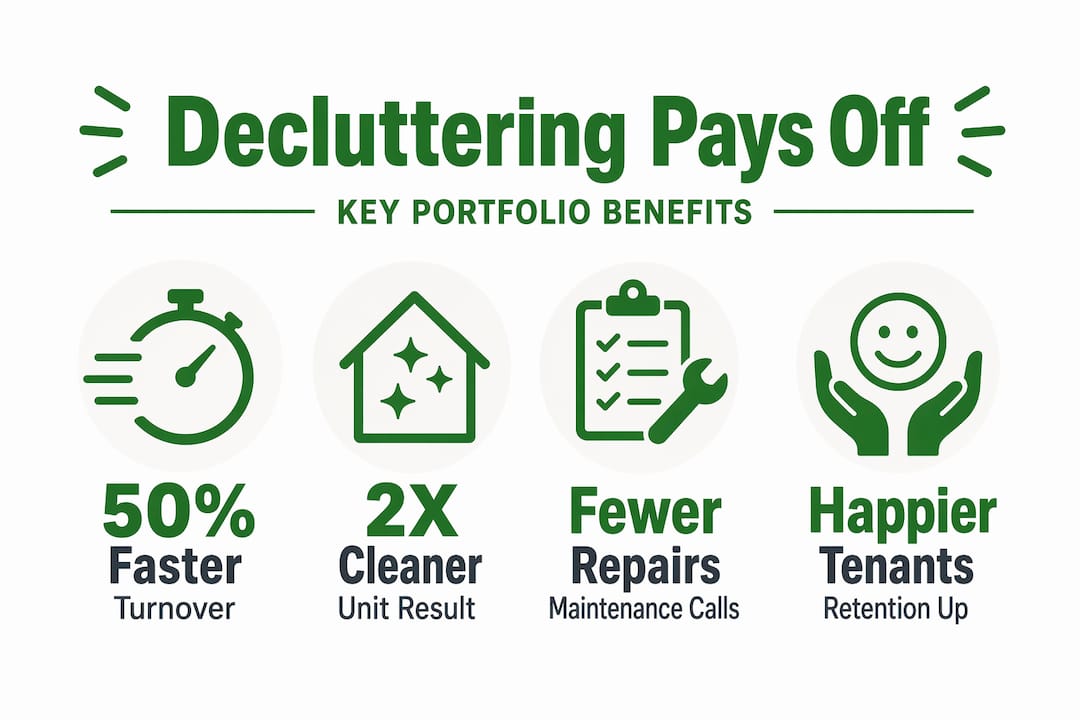
Faster unit turnover. A well-maintained unit at move-out takes fewer days to clean, photograph, list, and lease. Every extra day of vacancy is lost revenue.
Fewer maintenance complaints. Organized living environments reduce accidental damage, improve air circulation, and make it easier for residents to notice and report actual maintenance issues before they escalate.
Stronger tenant relationships. Tenants who experience fair, consistent, and proactive communication from their manager about property standards are more likely to renew, refer others, and comply with future requests.
Better market positioning. Units that photograph well and show clean attract better applicants. That affects both the quality of your tenant pool and the rents you can command.
Reduced legal exposure. Managers with documented inspection histories, consistent enforcement patterns, and completed accommodation processes are far better positioned to defend against complaints or lawsuits.
The early detection enabled by inspection cadence and lease-based housekeeping standards is the multiplier. Every intervention you make at the routine clutter stage is an intervention you don’t need to make at the hazardous accumulation stage, where the costs in time, money, and legal complexity are exponentially higher.
Understanding how property managers assist their portfolio through these systems is what separates reactive management from property stewardship that actually builds value over time. Reviewing a property manager cleanout guide tailored to compliance and efficiency is a practical next step for managers building these processes from scratch.
My take on decluttering as property stewardship
I’ve talked to enough property managers to know that most of them see decluttering as a necessary annoyance. A task that falls into their lap when a tenant gets out of control or a unit turns over badly. I think that framing is costing people real money.
What I’ve seen work consistently is treating decluttering as part of your property’s operating health. The managers who build it into their lease language from day one, who inspect on a real schedule, and who have two or three good vendor relationships in place are the ones who rarely end up in the worst situations. They don’t get blindsided because they’ve built systems that surface problems early.
The hoarding cases are the ones that taught me the most about the empathy-versus-documentation balance. You genuinely cannot help someone out of that situation with a punitive stance. But you also cannot help them if you don’t document every single step. Both things are true at the same time, and holding that tension is what the job actually requires.
My honest advice: stop thinking of vendor partnerships as a cost center and start treating them as part of your operational infrastructure. A reliable junk removal company in your contact list is worth more than another hour spent figuring out how to handle a tenant’s abandoned furniture. Build the relationships before you need them urgently.
— Joe
How Junkdispatch helps property managers take back control

If you manage properties in Massachusetts and you are tired of scrambling to find reliable removal help every time a unit turns over or a clutter situation escalates, Junkdispatch is built for exactly that workflow. Property managers across the state rely on Junkdispatch for fast, professional junk removal that works within their inspection and turnover schedules. Same-day availability, insured crews, and eco-conscious disposal mean you get the job done without adding more to your compliance checklist.
Whether you are dealing with a post-tenancy cleanout, a hoarding situation that has been professionally remediated, or routine bulk removal between tenants, the junk removal services in Essex County and surrounding Massachusetts areas from Junkdispatch are ready to move at your pace. Transparent pricing and online booking make it easy to build Junkdispatch into your standard vendor rotation. Reach out for a free estimate and find out why local property managers trust Junkdispatch as a dependable part of their property management support.
FAQ
What is the role of property managers in decluttering?
Property managers are responsible for setting housekeeping standards in lease agreements, conducting regular inspections to identify clutter, coordinating remediation efforts, and ensuring compliance with fair housing law when clutter is linked to a disability. The role goes well beyond cleaning oversight.
Can a property manager force a tenant to declutter?
Yes, but the process depends on the situation. Managers can issue cure notices tied to lease housekeeping clauses, but must follow a documented accommodation process if the clutter is connected to a recognized disability like hoarding disorder under the Fair Housing Act.
How often should property managers inspect for clutter?
Quarterly, biannual, or annual inspections are the recommended cadence depending on portfolio size and history. More frequent inspections allow for earlier detection and less costly interventions.
Why do property managers need junk removal vendors?
Professional junk removal vendors handle bulk removal faster than in-house staff can manage, provide documentation useful for deposit disputes, and keep vacancy timelines short. Pre-qualifying vendors before you need them is a key part of resilient property operations.
What are the fair housing risks with hoarding tenants?
Because hoarding disorder is recognized under the DSM-5 as a mental health impairment, it triggers Fair Housing Act obligations requiring managers to offer reasonable accommodations rather than pursuing immediate eviction. Failure to document and follow an interactive accommodation process creates significant legal exposure.
Recommended
Comments