Why Schedule Demolition Services Before Your Project Starts
- Joe Lusso
- 2 days ago
- 8 min read


TL;DR:
Scheduling demolition services early ensures timely completion by accommodating permits, utility disconnections, and hazardous material surveys. Proper planning with clear demolition plans reduces costs, prevents delays, and aligns operations with construction timelines. Recognizing the critical path of utilities and permits helps property owners avoid costly idle time and project setbacks.
Most property owners treat demolition as a starting gun. You hire a crew, they tear something down, and construction begins. The reality is far more layered than that. Knowing why schedule demolition services early matters comes down to one thing: every step before the wrecking crew arrives takes time you have not budgeted for. Permits, utility disconnections, hazardous material surveys, and debris logistics all operate on their own timelines. Miss any one of them and your project stalls before a single wall comes down.
Table of Contents
Key takeaways
Point | Details |
Permits take longer than expected | Utility disconnections alone require 2 to 4 weeks of advance scheduling before demolition can begin. |
Hazmat steps are non-negotiable | Pre-1978 structures require asbestos abatement and a 10-day EPA notice before any mechanical demolition starts. |
Planning prevents cost overruns | Clear demolition plans identify load-bearing elements early, reducing field assumptions that cause disputes and unexpected expenses. |
Debris timing is a safety issue | Misaligned dumpster schedules create site congestion and crew downtime that delay your entire project. |
Demolition is a transition, not a start | Aligning demolition completion with your construction start date reduces idle time for all downstream trades. |
Why schedule demolition services: the permit and utility reality
The single biggest reason to schedule demolition services well in advance is the permitting process. It cannot be rushed. Most municipalities in Massachusetts require a demolition permit before any structural work begins, and that permit approval depends on completing several steps that each have their own lead times.
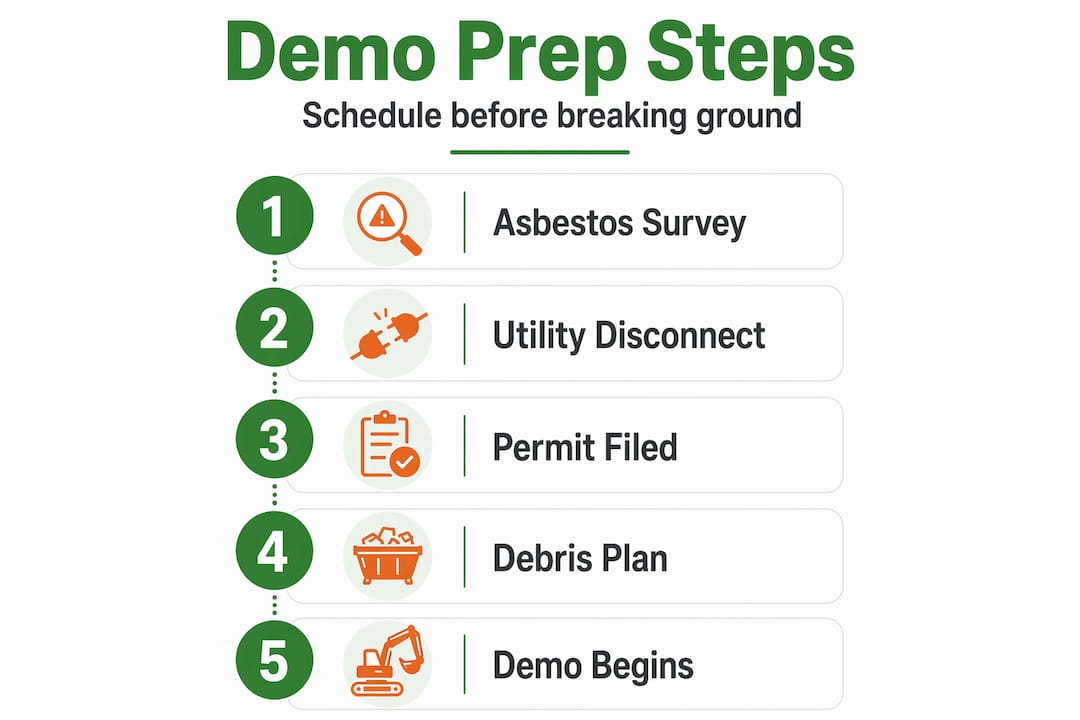
Utility disconnections are the first critical path item. Utility disconnections require 2 to 4 weeks of advance scheduling, and no reputable demolition crew will touch a structure until gas, water, and electricity are fully confirmed as disconnected. Trying to compress that window creates serious safety exposure and can trigger project shutdowns.
Here is where many property owners get blindsided:
Asbestos surveys: Any structure built before 1978 requires a professional asbestos inspection before the permit is issued. If asbestos is found, abatement must be completed before mechanical demolition begins.
EPA NESHAP notice: The EPA requires a written notification submitted 10 working days before demolition starts on structures subject to asbestos regulations. That is two full calendar weeks added to your timeline before a single tool swings.
Historic district review: If your property sits in a Massachusetts historic district, additional review boards may need to approve the demolition scope. These reviews can add weeks or months depending on the jurisdiction.
Zoning and structural documentation: Some municipalities require structural drawings or site plans as part of the permit application, which takes additional preparation time.
Each of these steps runs sequentially. You cannot submit for a permit until the asbestos survey is complete. You cannot schedule the crew until the permit is approved. Early scheduling synchronizes these prerequisites so they do not stack on top of each other and push your project start date back by months.
Pro Tip: Request your utility disconnection appointments and your asbestos inspection on the same week you decide to move forward with demolition. Even if your construction start is months away, these processes will fill the calendar faster than you expect.
How a demolition plan controls costs and sequencing
Scheduling demolition services without a documented demolition plan is like hiring a contractor without blueprints. You will get work done, but you will spend more time and money correcting assumptions than you would have spent planning in the first place.
Clear demolition drawings connect sequencing, safety, cost estimation, and permit documentation into a single reference point for every trade on site. When the plan identifies which walls are load-bearing and which can be removed in what order, your crew works with precision instead of making field calls that create liability.
Without a demolition plan | With a demolition plan |
Load-bearing elements discovered mid-demo | Structural risks identified before work begins |
Subcontractors waiting on each other | Sequenced trades with clear handoff points |
Permit delays due to missing documentation | Documentation package prepared in advance |
Budget surprises from field changes | Cost estimates tied to specific scope |
Disputes between trades over responsibility | Clear scope prevents overlap and gaps |
Poor field assumptions are one of the leading causes of cost overruns in renovation and construction projects. When a demolition crew removes something they assumed was non-structural and damages adjacent systems, the costs ripple forward into plumbing, electrical, and framing work. Demolition plans prevent that accidental damage by identifying safety risks before the crew mobilizes.
Scheduling demolition around a finalized plan also benefits your general contractor. They can prepare their own team based on a defined handoff date rather than waiting indefinitely for the site to be cleared.
Pro Tip: Ask your demolition contractor to review your renovation drawings before they finalize their scope. A second set of eyes on existing conditions often catches structural issues that were missed during the design phase.

Operational benefits of scheduling demolition services
Once you understand the permit and planning requirements, the operational side of scheduling becomes just as important. How you sequence the physical demolition work, and how you coordinate debris removal, determines whether your site runs safely or grinds to a halt.
Control the dismantling sequence. Controlled sequencing prevents unintended structural damage and reduces vibration risk, especially on urban properties close to neighboring buildings. Gradual dismantling with load redistribution monitoring keeps the site stable throughout the project.
Align your dumpster schedule with demolition phases. Dumpster scheduling must match demolition peaks to avoid crew downtime and safety hazards from full containers blocking site access. A missed pickup on day three of a five-day demo job means your crew is standing around or stacking debris in unsafe areas.
Plan debris hauling for off-peak hours. In denser Massachusetts communities, truck access during peak traffic hours creates logistical problems and adds time to every load. Scheduling haul-off during early morning windows keeps the work moving without competing with daily traffic.
Coordinate with neighboring properties when needed. In townhouses, shared wall buildings, or tight urban lots, neighbors may need advance notice of vibration-intensive work. Your demolition schedule gives you the documentation to communicate that professionally.
Build in a buffer for unexpected discoveries. Discovering buried oil tanks, unknown utility lines, or structural anomalies mid-project is more common than most property owners expect. A scheduled timeline with buffer days absorbs those discoveries without cascading delays.
Managing demolition debris in Massachusetts is not simply a matter of filling a dumpster. The type of material, the disposal destination, and the timing of removal all affect your project’s compliance status and cost. Proper scheduling puts all of that under your control rather than leaving it to chance.
Practical timing guidance for property owners
Understanding the importance of demolition scheduling is one thing. Knowing exactly when to start is another. Here is a framework that works for most residential and light commercial projects in Massachusetts:
10 to 12 weeks before your target demolition start: Commission your asbestos survey if the structure was built before 1978. Order structural drawings if your permit requires them. Contact your utility providers to initiate disconnection scheduling.
6 to 8 weeks before demolition: Submit your permit application with all required documentation. Confirm your asbestos abatement contractor if abatement is needed.
4 weeks before demolition: File the EPA NESHAP 10-day notice if applicable. Confirm your demolition contractor’s crew availability and mobilization date. Schedule your first dumpster delivery.
1 to 2 weeks before demolition: Confirm all utility disconnections are complete with written verification. Confirm debris hauling schedule with your removal service. Notify adjacent neighbors if vibration-intensive work is planned.
Demolition scheduled as a transition rather than a starting point reduces idle time for excavation and foundation trades waiting to mobilize. A post construction cleaning service can also be pre-scheduled around your demolition completion date to prepare the site for the next phase without added waiting.
Weather matters too. Massachusetts winters create ground conditions that complicate debris hauling, equipment access, and open-site work. If your project timeline gives you flexibility, targeting demolition between late spring and early fall avoids the worst of those complications. When delays do happen, having a documented schedule makes it far easier to communicate revised timelines to your contractor, permit office, and debris removal team.
Pro Tip: Share your full project timeline with your demolition contractor at your first meeting, not just the demo dates. The more context they have about what comes after, the better they can align their work to your downstream needs.
My take on why scheduling gets underestimated
I have seen property owners approach demolition with the same mindset they bring to hiring a moving company. Call someone, set a date, get it done. What they discover after the fact is that demolition operates on a completely different logic.
The critical path in any demolition project is not crew availability. It is utility verification and hazardous material readiness. Those two factors determine your actual start date more than anything else. Every property owner I have talked to who ran into serious delays traced it back to not starting those steps early enough.
What also gets missed is the cost of idle time. When your foundation contractor shows up and the site is not cleared because the dumpster service fell behind or the permit is still pending, you are paying people to wait. That is not a small cost. On a residential renovation, even two or three days of crew idle time can exceed what you would have spent scheduling everything properly from the start.
Demolition is a transitional phase, not an opening act. When you treat it that way, scheduling around a Massachusetts homeowner’s demolition guide becomes a practical tool rather than an afterthought. The projects that finish on time are almost always the ones where the property owner started scheduling demolition before they thought it was necessary.
— Joe
Ready to schedule demolition services in Massachusetts?
If you are planning a renovation, land clearing, or unsafe structure removal in Massachusetts, Junkdispatch has the experience and scheduling infrastructure to keep your project on track.

Junkdispatch handles demolition and debris removal for both residential and commercial properties across Massachusetts, with insured crews and transparent pricing. From coordinating debris haul-off to aligning removal schedules with your permit timelines, the team takes the operational complexity off your plate. Online booking, free estimates, and same-day availability mean you can move fast when your permits clear. Whether you are in Essex County or the greater Reading area, Junkdispatch is ready to help you move from demolition to construction without the delays that sink most projects.
FAQ
Why do you need to schedule demolition services early?
Early scheduling allows time for permit applications, utility disconnections, and asbestos surveys. These steps often take 6 to 12 weeks and cannot be compressed, so starting late pushes your entire project timeline back.
What permits are needed before demolition begins?
Most Massachusetts municipalities require a demolition permit, which depends on completed utility disconnections and hazardous material inspections. Pre-1978 structures also require EPA asbestos notification submitted 10 working days before demolition.
How does debris scheduling affect a demolition project?
Misaligned dumpster pickups create site congestion and crew downtime that delay the entire project. Synchronized debris hauling with demolition phases keeps the site safe and the work moving.
When should demolition be completed relative to construction?
Demolition should finish at the same time your construction crew is ready to mobilize. Treating demolition as a transition between phases reduces idle time and avoids paying trades to wait on a cleared site.
Does demolition scheduling matter for small residential projects?
Yes. Even small-scale residential demolition in Massachusetts requires permits and utility disconnections that have fixed lead times. The process is shorter than commercial work but the same regulatory steps apply.
Recommended
Comments