Eco-friendly disposal: Reduce costs and protect Massachusetts
- Joe Lusso
- 1 hour ago
- 10 min read

TL;DR:
Improper waste disposal pollutes air, water, and contributes to climate change and health issues.
Massachusetts enforces waste bans and promotes eco-friendly methods like composting and recycling.
Professional junk removal services support economic growth, create jobs, and help residents save money.
Most people picture a truck hauling junk to a landfill and call it done. What they rarely consider is what happens next. Improperly discarded waste pollutes air and water, attracts pests, spreads disease, and drains local economies in ways that never make the front page. For Massachusetts homeowners and businesses, disposal choices ripple outward in ways most never anticipate. This article walks through why eco-friendly junk disposal matters far more than a cleaner curb, and how practical solutions, both personal and professional, are reshaping our state for the better.
Table of Contents
The environmental impact of improper disposal in Massachusetts
How eco-friendly disposal works: Methods and laws in Massachusetts
Financial and community benefits: What eco-disposal saves and supports
Best practices: Eco-friendly disposal tips for Massachusetts homes and businesses
Why most people underestimate the power of eco-friendly disposal
How Junk Dispatch supports eco-friendly disposal in Massachusetts
Key Takeaways
Point | Details |
Reduces pollution | Eco-friendly disposal minimizes air, water, and soil contamination across Massachusetts. |
Lowers disposal costs | Composting and recycling are less expensive than traditional trash disposal, especially with local bans. |
Boosts local economies | Waste diversion laws and services create jobs and reduce overall economic losses for the community. |
Supports compliance | Using professional junk removal helps residents and businesses avoid fines and stay up to date with state requirements. |
The environmental impact of improper disposal in Massachusetts
With the stakes framed, it’s worth looking closely at how everyday disposal habits are shaping Massachusetts’s environment and the health of its communities.
Landfills are far more than inconvenient neighbors. When organic material like food scraps, yard waste, and untreated wood gets buried, it breaks down without oxygen in a process called anaerobic decomposition. That process produces methane, a greenhouse gas that is roughly 80 times more potent than carbon dioxide over a 20-year window. Massachusetts’s food waste ban boosts business by diverting organic waste from exactly this outcome, reducing harmful methane emissions at the source. Yet thousands of tons of organic material still end up in landfills every year because too many people simply don’t know better.
Water contamination is equally serious. Landfill leachate, the liquid formed as water filters through buried waste, can carry heavy metals, synthetic chemicals, and pathogens directly into groundwater and nearby streams. Air pollution from open burning, unregulated dumping, and landfill off-gassing affects neighborhoods in measurable ways. When waste is mismanaged at scale, the real-world impact extends to economic losses, lower property values, and increased health care costs for surrounding communities. These are not abstract statistics. They affect the streets where you live and work.
Composting and recycling don’t just reduce what goes into landfills. They actively improve soil quality, sequester carbon, and prevent excess nutrients from polluting local waterways.
The good news is that practical alternatives exist, and they work. Here’s a quick summary of the most common environmental harms from improper disposal:
Methane emissions from organic waste in landfills accelerate climate change.
Water pollution from landfill runoff contaminates drinking water sources.
Air contamination from illegal burning degrades local air quality.
Pest infestations flourish in poorly managed waste sites, spreading disease.
Soil degradation occurs when hazardous materials leach into the ground.
For Massachusetts residents, the connection between junk removal and environmental safety is direct. Understanding that connection is the first step toward making better choices. To go deeper on what those better choices look like, a solid eco-friendly disposal guide tailored to local conditions is invaluable. And if you’re dealing with unwanted pests that follow poor waste management, eco pest control solutions are a smart complement to cleaner disposal practices.
How eco-friendly disposal works: Methods and laws in Massachusetts
Understanding the dangers of poor disposal, let’s explore what practical eco-friendly solutions look like in Massachusetts and how local law is pushing real change.
Massachusetts has built one of the most progressive waste management frameworks in the country, and it shows in the numbers. The state’s commercial food waste ban applies to any business or institution generating 0.5 tons or more of food waste per week. Under this ban, those businesses must divert waste through composting, anaerobic digestion, food rescue programs, or other approved methods. The results are striking. Compliant facilities grew from 1,350 in 2014 to over 4,150 in 2024, a threefold expansion that has created jobs and reduced the state’s organic waste footprint substantially.

Mattress and textile bans are another critical piece of the puzzle. These bans prohibit mattresses and textiles from going to landfills, pushing them into recycling streams instead. The results are impressive. Mattress recycling nearly doubled to 396,000 units in 2023, and textile recovery hit 45,000 tons in the same period. Beyond the environmental win, keeping mattresses out of landfills reduces fire risk and prevents structural instability caused by the hollow spaces mattresses create as they break down underground.
Here’s a side-by-side look at the primary eco-friendly disposal methods available in Massachusetts:
Method | Best for | End result |
Composting | Food scraps, yard waste, organics | Nutrient-rich soil amendment |
Anaerobic digestion | Food waste at scale | Renewable energy, liquid fertilizer |
Recycling | Metals, glass, paper, electronics | Raw material recovery |
Donation/reuse | Furniture, clothing, appliances | Extended product life, community support |
Drop-off programs | Bulk items, hazardous materials | Controlled, compliant processing |
Here’s a practical step-by-step process for Massachusetts residents starting to clean up their disposal habits:
Audit your waste stream. Spend one week separating what you throw out into categories: organics, metals, paper, electronics, textiles, and general trash.
Find your local drop-off programs. Most Massachusetts cities and towns run curbside organics collection and bulk item drop-offs.
Separate food scraps. Start composting at home or use your curbside organics bin if your town provides one.
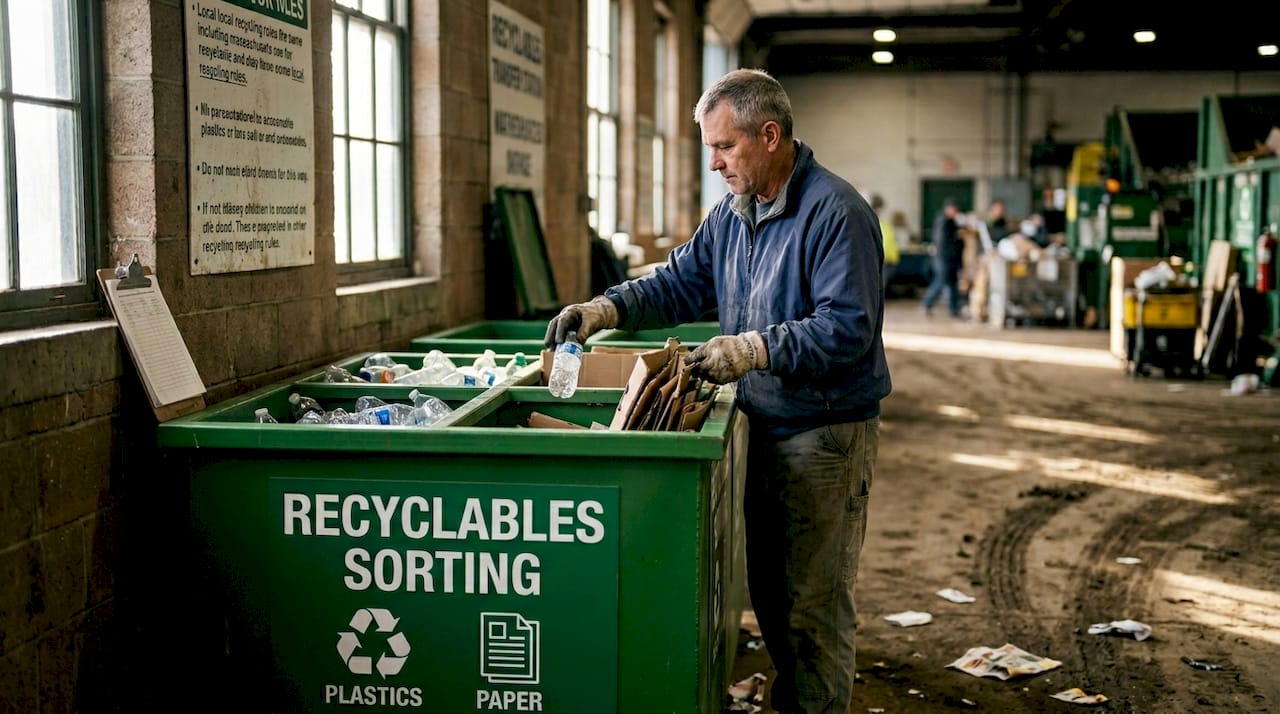
Sort recyclables correctly. Contamination, mixing non-recyclables into recycling bins, is one of the biggest barriers to effective recycling.
Plan for big-item disposal. Mattresses, appliances, and electronics all have specific disposal rules in Massachusetts. Know them before your next cleanout.
Pro Tip: Many Massachusetts municipalities offer free or low-cost drop-off days for hazardous household waste, electronics, and bulk items. Check your town’s schedule at the start of each year so you’re never caught tossing something that should be diverted.
For businesses and homeowners ready to take eco-conscious junk disposal seriously, working with a compliant junk removal service removes the guesswork entirely.
Financial and community benefits: What eco-disposal saves and supports
With knowledge of available methods, it’s essential to see the bottom-line and community value eco-disposal brings to everyone involved in Massachusetts.
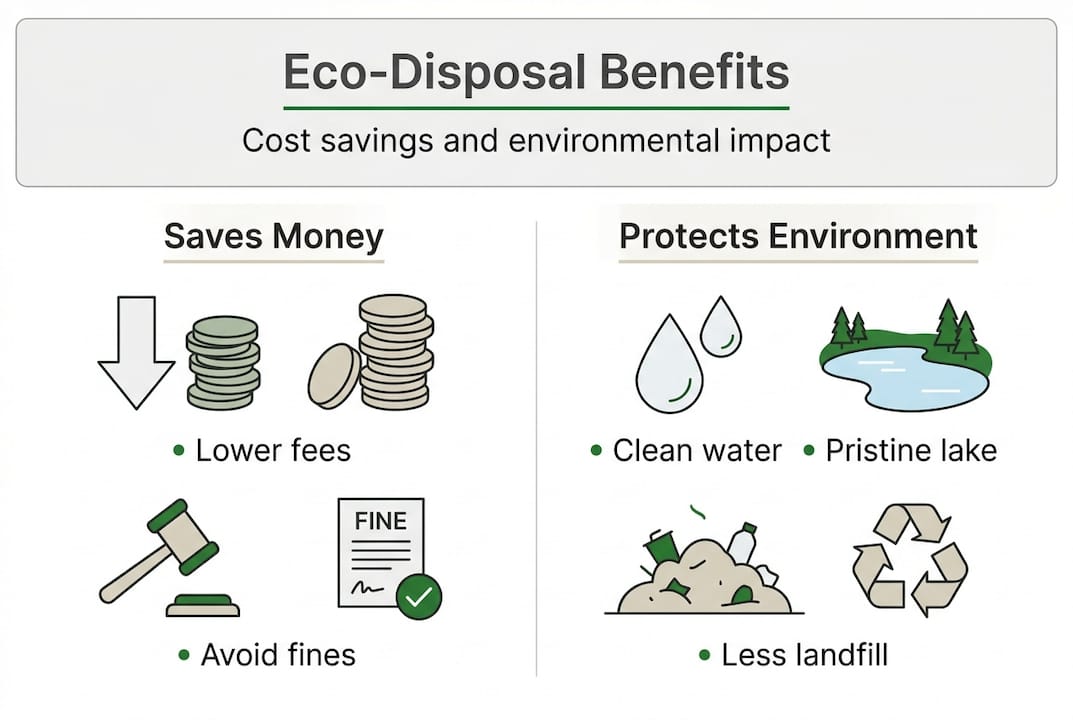
Let’s talk money, because eco-friendly disposal isn’t just good for the planet. It’s good for your wallet and your community. Massachusetts has some of the highest landfill tipping fees in the country, running between $110 and $140 per ton. Composting, by comparison, costs around $81 per ton versus $139 per ton for traditional trash disposal, according to the Cambridge Zero Waste Master Plan. That’s a real, measurable saving that homeowners and businesses can realize just by sorting better.
Massachusetts’s food waste diversion program has created 1,676 jobs and generated $143 million in labor income and $390 million in total industry activity, according to a 2025 economic impact analysis.
These aren’t small numbers. The waste diversion economy is a growth sector, and it benefits local workers and businesses. Here’s a snapshot of the economic case:
Disposal type | Approximate cost per ton | Local jobs supported |
Landfill (traditional trash) | $110 to $140 | Minimal |
Composting (organic waste) | $81 | Significant local workforce |
Anaerobic digestion | Varies, often lower long-term | High, specialized roles |
Recycling programs | Variable, often subsidized | Moderate to high |
Beyond individual savings, eco-disposal creates community-level benefits that are easy to overlook:
Food rescue programs redirect edible food from businesses to local food banks, reducing hunger while diverting waste.
Textile donation keeps usable clothing and fabric in circulation, reducing the need for new production.
Appliance recycling recovers metals that would otherwise require energy-intensive mining.
Job creation in the diversion sector supports local workers with stable employment in composting, recycling, and resource recovery.
For businesses especially, ignoring eco-disposal rules carries real financial risk. Fines for non-compliance with Massachusetts’s waste bans can be significant, and enforcement is increasing as the state expands its monitoring capacity. The smarter play, financially and reputationally, is proactive compliance. Learning how to manage junk removal efficiently means fewer surprises, lower costs, and better outcomes across the board. You can also explore the broader sustainability benefits of junk removal to see how professional services build long-term value.
Best practices: Eco-friendly disposal tips for Massachusetts homes and businesses
Now that benefits are clear, here’s how you can start taking practical action, at home and for your business, starting today.
Getting eco-friendly disposal right is mostly about building better habits and knowing where to send specific materials. The good news is that professional help is available for every step of the process.
For homeowners, here’s where to start:
Use curbside organics programs. Many Massachusetts towns now offer weekly organics pickup. Use it for food scraps, coffee grounds, and soiled paper.
Separate metals. Steel, copper, and aluminum are all high-value recyclables. Keep a separate bin and drop them at a local scrap yard or recycling center.
Drop off electronics properly. E-waste contains heavy metals that should never go in the trash. Most municipalities have designated collection points.
Donate before you toss. Furniture, clothing, and appliances in decent shape can go to local Habitat for Humanity ReStores, thrift shops, or community groups.
Know the bans. Mattresses, tires, and textiles are all banned from Massachusetts landfills. Familiarize yourself with the full list.
For businesses, the compliance picture is more complex, but manageable with the right partner. Here’s a practical checklist:
Calculate your weekly food waste. If you’re generating 0.5 tons or more, you’re legally required to divert it from the landfill.
Partner with a licensed hauler. Make sure your waste hauler can document where organic material goes.
Train staff on sorting. Contamination is the enemy of recycling. A brief training session for employees pays off quickly.
Schedule professional cleanouts. Periodic office, warehouse, or facility cleanouts generate mixed materials. A professional junk removal service ensures every category gets handled correctly.
Audit annually. Waste generation patterns change. Reassess your disposal setup every year to stay compliant and cost-effective.
Professional junk removal services in Massachusetts sort 60 to 80 percent of collected materials for recycling, donation, or composting, diverting a huge share of what might otherwise go straight to a landfill. That’s a massive win when you factor in Massachusetts’s tipping fees and the growing list of banned materials. For appliance recycling specifically, professional services ensure that refrigerants and other hazardous components are handled safely, which protects both the environment and your legal standing.
Pro Tip: Before scheduling a cleanout, walk through your space and flag items by category. Even a rough sort takes ten minutes but can dramatically improve how efficiently a junk removal crew processes your materials, and potentially lower your cost.
Why most people underestimate the power of eco-friendly disposal
After walking through all the what, why, and how, here’s an honest perspective on what’s really happening in Massachusetts and what it means for you.
We’ve been in this work long enough to notice a consistent pattern. Most people think eco-friendly disposal is a nice-to-have, something for businesses with sustainability departments or homeowners who have extra time. That assumption costs them money, creates legal exposure, and misses an enormous opportunity.
Massachusetts’s waste bans are not symbolic gestures. They are legally enforced, increasingly monitored, and financially consequential. Yet a surprising number of business owners still haven’t fully adjusted their operations. The reasons are understandable: the rollout has been gradual by design, giving industries time to build capacity and understand the rules. But gradual doesn’t mean optional, and the window for easy adjustment is closing as enforcement thresholds tighten.
What surprises us most is how often homeowners and small business owners underestimate the cumulative financial benefit of proper sorting. Cutting even a fraction of your waste stream out of the landfill-bound category reduces your disposal costs in real, immediate terms. Add in the job creation, the community food rescue programs, and the reduced pest and health risks in your neighborhood, and the math becomes overwhelming. Eco-friendly disposal is genuinely the better deal across almost every metric.
The other thing people miss is that small, consistent actions compound. Sorting your organics correctly, donating furniture instead of dumping it, or working with a compliant junk removal service are not heroic acts. They are ordinary decisions with measurable effects. When enough people and businesses in Massachusetts make them, the aggregate result is thousands of jobs, hundreds of millions in economic activity, cleaner water, and a lower carbon footprint for the entire state. We’ve seen this play out firsthand, and the junk removal sustainability picture is genuinely compelling when viewed at scale.
The honest truth is that this isn’t really about being an environmentalist. It’s about being informed. The rules exist, the incentives are real, and the infrastructure is ready. The only thing missing in most cases is awareness and a practical first step.
How Junk Dispatch supports eco-friendly disposal in Massachusetts
If you’re ready to make your next junk removal project truly green, here’s how a trusted local partner can help you take that practical first step.
At Junk Dispatch, we sort collected materials for 60 to 80 percent recycling, donation, and composting on every job, whether you’re clearing a garage in Reading, MA or handling a full commercial cleanout anywhere across Essex County. Our insured crews are trained on Massachusetts’s waste bans and disposal regulations, so you get compliance and convenience in a single call.
We handle everything from furniture and appliances to yard waste, electronics, and construction debris, keeping as much as possible out of landfills and in line with state requirements. Our online booking, free estimates, and transparent pricing mean no guesswork for busy homeowners, property managers, and business owners. Whether it’s a same-day removal or a scheduled cleanout, Junk Dispatch makes eco-friendly disposal easy, affordable, and fully compliant across Massachusetts.
Frequently asked questions
How effective are junk removal services at recycling in Massachusetts?
Professional junk removal services in Massachusetts typically sort 60 to 80 percent of collected items for recycling, donation, or composting, keeping the majority of waste out of landfills.
What materials can be composted or recycled under Massachusetts bans?
Organics, metals, textiles, electronics, mattresses, and yard waste are all prioritized for composting or recycling. Mattress recycling reached 396,000 units in 2023 and textile recovery hit 45,000 tons under the current ban framework.
Does eco-friendly junk disposal really save money for homeowners?
Yes. Composting costs roughly $81 per ton versus $139 per ton for traditional landfill disposal in Massachusetts, which carries some of the highest tipping fees in the country.
How do new food waste bans benefit the local economy?
Massachusetts’s food waste diversion ban has created 1,676 jobs and generated $390 million in total industry activity, making it one of the most economically productive environmental policies in the state.
Do I need to sort waste myself or will pros handle it?
Professional junk removal crews handle all sorting for compliance with Massachusetts bans, but sorting at home before a pickup reduces contamination and can improve the overall recycling rate for your job.
Recommended
Comments