Why Manage Construction Waste: Costs, Compliance, and Savings
- Joe Lusso
- 2 days ago
- 9 min read

TL;DR:
Effective construction waste management reduces disposal costs, improves site safety, and enhances project profitability.
Implementing source separation, proper documentation, and circular strategies ensures compliance and long-term environmental benefits in Massachusetts.
Most construction managers treat waste management as a box to check before the inspector shows up. That mindset is costing you money every single week. Understanding why manage construction waste is not just about staying legal. It is about running a tighter, safer, more profitable job site. Poor waste handling drives up disposal fees, creates safety hazards, and puts your project timeline at risk. Get it right, and you unlock real savings, smoother operations, and a competitive edge that clients and regulators both notice.
Table of Contents
Key takeaways
Point | Details |
Segregation cuts disposal costs | Separating waste streams reduces disposal costs by 30 to 50% compared to mixed waste loads. |
Safety improves with managed waste | Organized waste removal reduces trip hazards, fire risks, and manual handling injuries on active job sites. |
Source reduction prevents waste first | Accurate quantity takeoffs and just-in-time delivery reduce how much waste your site generates before removal is even needed. |
Circular strategies deliver long-term ROI | Design for disassembly and material recovery approaches carry 70% ROI and reduce raw material exposure over project lifecycles. |
Local compliance requires documentation | Massachusetts builders must work with licensed waste carriers and maintain proper records to avoid penalties and project delays. |
Why manage construction waste on every project
Construction waste covers more than the obvious pile of broken drywall at the end of a renovation. The category includes demolition debris, packaging materials, off-cuts of lumber and metal, concrete rubble, insulation scraps, and surplus materials ordered above what the job needed. Taken together, C&D debris accounts for roughly 37% of the waste stream in the EU and over 600 million tonnes annually in the US alone. That is not a minor footnote. It is a massive environmental and logistical problem that lands directly on your job site.
The importance of construction waste management becomes obvious when you look at what happens without it. Unmanaged waste fills landfills with material that could have been recovered, recycled, or resold. It creates liability exposure for project owners and general contractors. And in Massachusetts, where environmental regulators take waste diversion seriously, poor documentation and unlicensed disposal put your permits at risk.
Construction waste management fits into every phase of a project lifecycle, not just the cleanup at the end. Here is where it shows up:
Preconstruction: Material quantity planning, procurement decisions, and supplier agreements that reduce excess deliveries
During construction: On-site segregation, waste tracking, and scheduled collection to prevent pile-up
Demolition and close-out: Debris categorization, recycling diversion, and final waste transfer documentation
Post-project: Reporting for green building certification, client sustainability audits, and regulatory compliance
When you treat waste management as embedded in the project rather than tacked on at the end, you make better decisions at each stage. That is the foundation of the importance of construction waste management for both compliance and profitability.
The real economic and operational benefits
Here is where the argument for managing waste gets concrete. Sites that segregate waste at source see disposal cost reductions of 30 to 50% compared to sending mixed loads off-site. If you are spending $10,000 per project on disposal, that gap matters. And the savings compound when you factor in the hidden costs most managers overlook.
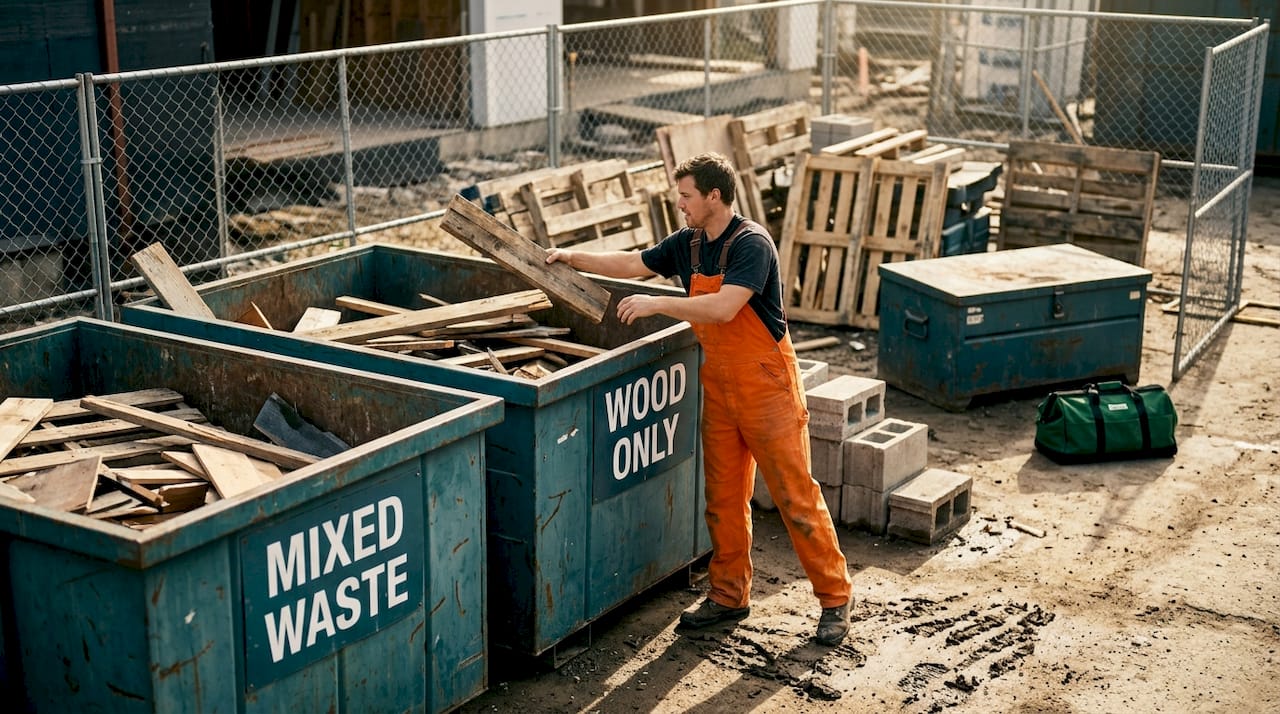
Mixed waste loads carry costs beyond the tipping fee itself. Transport inefficiencies, load rejection risks, and the administrative overhead of correcting documentation all slow project flow in ways that rarely get traced back to the waste decision. When a load gets rejected because plasterboard ended up in a timber skip, you pay to haul it back, re-sort it, and reschedule the collection. That is a morning of lost labor for something completely avoidable.
The operational benefits of managing construction waste extend well beyond the dumpster. A cleaner site is a safer site. Managed waste reduces trip hazards, manual handling injuries, and fire risks, which translates to fewer incident reports, lower insurance exposure, and a work environment your subcontractors actually want to return to. Safety performance also affects your reputation with general contractors and clients who monitor OSHA metrics.
Pro Tip: Set up a brief end-of-day waste check as part of your foreman’s daily close-out routine. Five minutes of sorting prevents a $500 load rejection the following morning.
Here is a breakdown of the core benefits you gain from structured waste management:
Reduced disposal fees through segregated skip use and contracted recycling streams
Lower labor costs because sorted waste moves faster and does not require re-handling
Fewer project delays caused by rejected loads or compliance inspections
Improved site safety with clear pathways, labeled waste zones, and reduced combustible pile-up
Stronger client relationships when sustainability reporting shows real diversion numbers
These are not soft benefits. They show up in your project margin, your safety record, and your ability to win the next contract.
Practical methods for managing construction site waste
The best strategies for construction waste reduction start before the first shovel hits the ground. Prevention at the design and procurement stage reduces overall waste and carbon footprint more effectively than any downstream sorting system. Accurate quantity takeoffs, just-in-time material deliveries, and modular design approaches all cut what arrives on site in the first place.
Once the project is underway, on-site segregation is your most powerful tool. The following steps create a system that most crews can follow without special training:
Set up labeled, color-coded skips at each major work zone. Separate containers for concrete, timber, metals, general waste, and hazardous materials keep streams clean from day one.
Use images on signage, not just text. Multilingual crews understand a picture of plasterboard faster than a label that reads “gypsum only.” Visual cues cut contamination rates substantially.
Position skips near work zones. If a worker has to carry waste 100 feet to the right container, they will use the wrong one. Proximity drives compliance.
Run regular toolbox talks on waste handling. A 10-minute conversation at the start of each week reinforces what goes where and why it matters.
Conduct contamination checks before collections. A single contaminated bag can reclassify an entire load as mixed waste, raising disposal costs substantially. Catch it before the truck arrives.
Use only licensed waste carriers and maintain your documentation. Waste Transfer Notes are legally required records for waste transfers, and fines for non-compliance can reach substantial amounts. Keep records for at least two years.
Pro Tip: When hiring subcontractors, include waste handling requirements in their scope of work documents, not just your site rules. Accountability starts in the contract.
Check out these construction debris disposal tips specifically designed for Massachusetts projects if you want a practical reference for local recycling and diversion options.
Circular economy approaches and sustainable waste practices
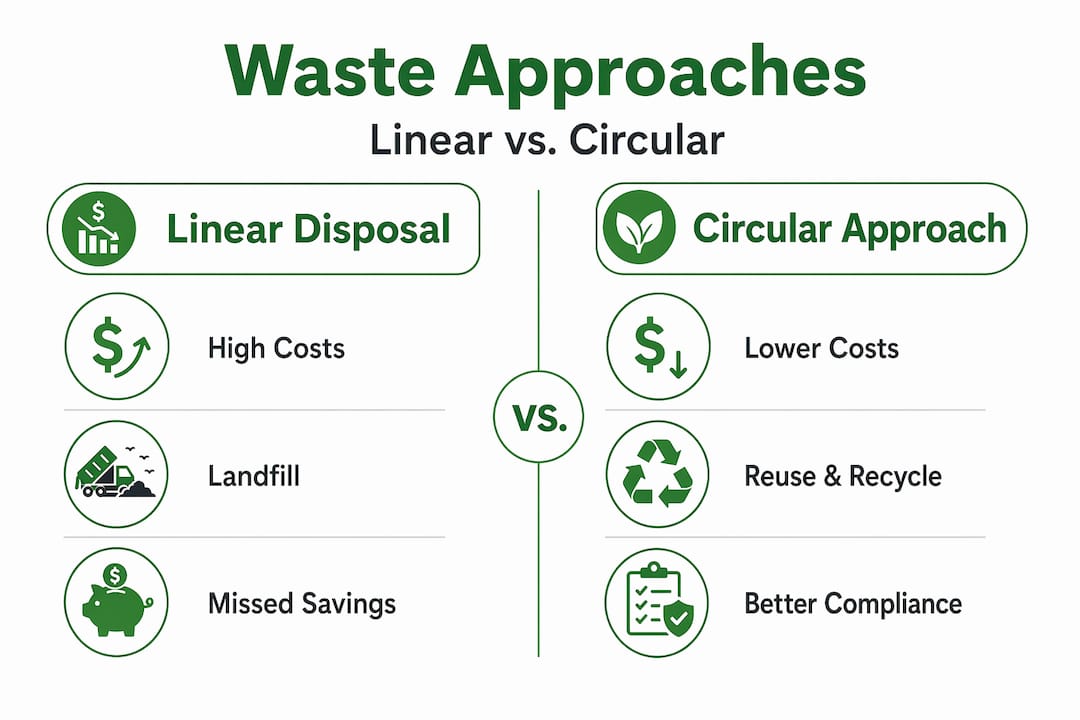
The conversation around construction waste disposal methods has shifted dramatically over the last decade. Sending debris to a licensed landfill used to be the end goal. Now, the most forward-thinking project teams treat waste as a resource stream with recoverable value. This is the core principle behind circular construction: keep materials in use as long as possible, then recover them efficiently at end of life.
Here is how linear and circular approaches compare across key metrics:
Factor | Linear disposal | Circular approach |
Material cost exposure | High, tied to raw material prices | Reduced through material recovery and reuse |
Long-term disposal cost | Increases with landfill taxes and tipping fees | Lower over project lifecycle |
Regulatory alignment | Meets minimum compliance | Exceeds diversion mandates, supports green certification |
Design consideration | None or minimal | Requires design for disassembly planning |
ROI timeline | Immediate but limited savings | 70% ROI on design for disassembly investments over lifecycle |
Jurisdictions across the US increasingly mandate 50 to 75% waste diversion by weight, which means circular strategies are not optional for large projects much longer. Teams that build diversion into their planning now will not scramble when those requirements tighten.
There is also a financing angle worth knowing. Projects with documented sustainability practices, including waste diversion rates, are increasingly favored for green financing and public tenders. A well-documented waste management plan can be a competitive differentiator when bidding on public or institutional work.
You can also explore eco-friendly solutions for construction debris in Massachusetts for practical guidance on materials that can be diverted from landfill and where to send them.
Applying waste management principles in Massachusetts
Massachusetts has active MassDEP regulations governing construction and demolition waste, and local municipalities often layer additional requirements on top. Working with unlicensed haulers or failing to document waste transfers can result in stop-work orders, fines, and project delays that far exceed what proper compliance would have cost.
The best practices for construction waste management in Massachusetts include:
Verify your waste hauler’s license through MassDEP before signing any hauling contract. Using an unlicensed carrier transfers liability directly to you.
Document everything. Keep copies of all waste manifests, tip receipts, and transfer records. If you face an audit or a dispute, that paper trail is your only defense.
Separate hazardous materials early. Lead paint, asbestos, and certain treated woods require separate handling and certified disposal under Massachusetts law.
Identify local recycling facilities before your project starts. Concrete, metal, and clean wood all have viable recycling outlets in the Massachusetts market. Knowing where they are before demolition starts saves time and money.
Partner with a professional debris removal service that understands local compliance requirements and can provide documentation as part of the service.
For a deeper look at how to manage construction debris within Massachusetts regulations, Junkdispatch has published a practical guide tailored to local project requirements.
Understanding why remove construction debris goes beyond cleanliness. It connects directly to your project’s legal standing and your ability to close out permits without complications.
My honest take on what most job sites get wrong
I have watched construction teams invest seriously in safety programs, quality control, and project scheduling while treating waste management as an afterthought for the site foreman to sort out. That inconsistency does not make sense to me anymore.
The crews who resist waste segregation are usually not lazy. They just have never been shown a cost breakdown that connects their behavior at the skip to the project’s disposal bill. When you show someone that a contaminated load cost the project $800 and a day of rescheduling, the conversation changes fast.
What I have found is that the teams running the tightest waste programs are also the ones with the cleanest safety records and the most predictable project timelines. Those things are not a coincidence. They reflect the same underlying discipline. When a site has a system for waste, it usually has a system for everything else too.
The resistance I see most often comes from subcontractors who work across multiple job sites and do not want to learn a new protocol at every location. The fix is simple: standardize your waste system, make the signage visual, and train once rather than hoping people figure it out. It takes about two weeks to become habit. After that, you stop thinking about it because it just runs.
— Joe
Get professional construction debris removal in Massachusetts
Running a clean, compliant job site in Massachusetts means having a reliable removal partner, not just a skip company that shows up when it is convenient.

Junkdispatch serves construction teams across Massachusetts with fast, eco-conscious debris removal that handles everything from concrete and drywall to mixed demolition loads. The crews are insured, trained on proper waste categorization, and can provide the documentation your project close-out requires. Whether you need scheduled site clearance throughout a renovation or a one-time debris haul after demolition, Junkdispatch offers same-day availability and transparent pricing with no hidden fees. For teams working in Eastern Massachusetts, Junkdispatch covers junk removal in Essex County and provides construction debris removal in Reading, MA with the same professional standard. Get a free estimate online and keep your site clean, legal, and on schedule.
FAQ
Why does construction waste management save money?
Segregating waste at source reduces disposal costs by 30 to 50% compared to mixed loads. Additional savings come from fewer load rejections, less re-handling labor, and avoiding compliance fines.
What are the main construction waste disposal methods?
The primary methods are source reduction, on-site segregation into dedicated skips, recycling through certified facilities, material reuse, and landfill disposal for residual waste that cannot be diverted.
Why recycle construction materials instead of sending them to landfill?
Recycling recovers value from materials like concrete, metal, and timber, reducing raw material costs and meeting diversion mandates that many jurisdictions now require at 50 to 75% by weight.
What documentation is required for construction waste in Massachusetts?
Massachusetts projects require working with licensed waste carriers and maintaining waste transfer records. MassDEP regulations govern proper categorization and disposal, particularly for hazardous materials like asbestos and lead paint.
How does poor waste management affect project timelines?
Mixed waste loads can be rejected at disposal facilities, requiring re-sorting and rescheduling that delays project close-out. Compliance failures can also trigger stop-work orders that halt progress entirely until violations are resolved.
Recommended
Comments