What Is Debris Recycling? A Practical Guide
- Joe Lusso
- 2 days ago
- 8 min read

TL;DR:
Debris recycling involves recovering and reusing construction and demolition materials instead of sending them to landfills. Proper source separation and working with professional services can significantly improve recycling rates, reduce costs, and support local economies and environmental goals. Implementing effective debris recycling practices requires planning, sorting, and partnering with responsible haulers for sustainable waste management.
Most people assume debris is trash. You haul it out, a truck takes it away, and that’s the end of it. But what if a significant portion of that debris could be recovered, processed, and turned into new materials? That’s exactly what debris recycling does. Understanding what is debris recycling and how it works can shift your entire approach to waste on a construction project, home renovation, or commercial cleanout. For Massachusetts homeowners and organizations, it’s not just an environmental consideration. It’s often a smarter, more cost-effective way to manage waste.
Table of Contents
Key takeaways
Point | Details |
Debris recycling defined | It’s the recovery and reuse of construction and demolition materials rather than sending them to a landfill. |
Sorting drives success | Clean, well-separated debris recovers far better than mixed loads, making pre-sorting worth the effort. |
Real economic benefits | Recycling debris conserves resources, reduces disposal costs, and supports local job creation in Massachusetts. |
Follow a clear process | Collection, processing, and remanufacturing are the three core stages of any effective debris recycling program. |
Local services help | Working with a professional debris removal service makes compliance and recycling execution significantly easier. |
What is debris recycling and what can be recycled
Debris recycling is the process of separating, collecting, and reprocessing waste materials from construction, demolition, renovation, or disaster cleanup so those materials can be used again rather than buried in a landfill. At its core, it treats waste as a resource rather than a problem.
Construction debris is predominantly mineral and non-hazardous. That means a large share of what gets torn out during a renovation or demo project is actually recoverable. The key distinction is between clean mineral debris and mixed waste. Clean concrete, brick, or wood recovered through careful sorting has strong recycling potential. Mixed loads contaminated with paint, insulation, or household garbage are far harder to process and often end up in landfill anyway.
Common materials that qualify for debris recycling include:
Concrete and masonry — crushed and reprocessed into recycled aggregate for road base or new construction
Wood — chipped into mulch, biomass fuel, or reclaimed for structural reuse
Metals (steel, copper, aluminum) — melted down and recast into new metal products
Asphalt — one of the most recycled materials in the US, routinely reused in road paving
Drywall (gypsum) — ground down and reused as raw material in new drywall manufacturing
Soil and fill — screened and reused as clean fill or in landscaping applications
Brick — cleaned and either resold for reuse or crushed into aggregate
What you cannot recycle easily are materials containing hazardous substances. Asbestos-containing materials, lead paint residue, and chemical-soaked debris require specialized handling outside of standard recycling streams.
Pro Tip: Separate your debris by material type before any hauler arrives. A sorted pile of concrete takes minutes to load and process. A mixed pile of concrete, wood scraps, and old drywall creates contamination problems that can disqualify the whole load from recycling.
The debris recycling process
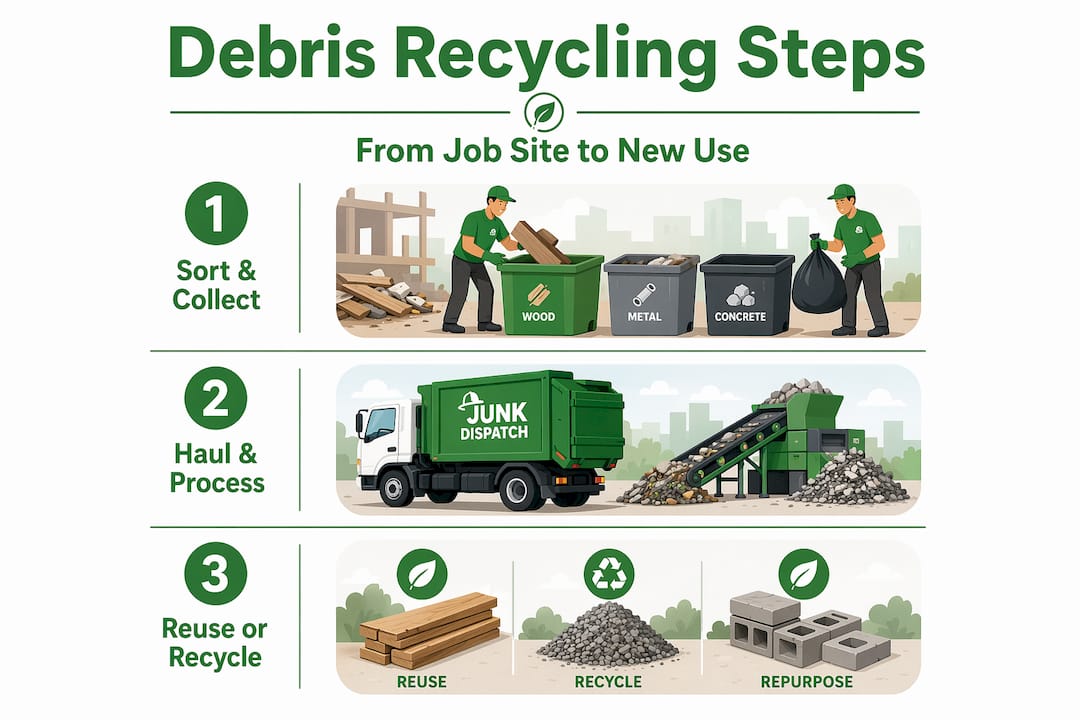
Understanding the debris recycling process helps you recognize why sorting and preparation at the source matter so much. The US EPA recycling system breaks the process into three main stages: collection, processing, and remanufacturing. For debris specifically, those stages look like this:
Collection and on-site pre-sorting. Materials are separated by type at the job site or cleanup location. Some contractors use labeled containers for different material streams. Others rely on manual sorting before loading. Either way, keeping materials clean and separated here determines everything that follows.
Transportation to a processing facility. Sorted materials are hauled to a materials recovery facility (MRF) or a specialized C&D recycling facility. Mixed loads can go to a mixed waste processing center, though recovery rates are lower.
Pre-crushing and size reduction. Heavy concrete and masonry go through crushers to reduce size for screening. Equipment like concrete pulverizers and hydraulic splitters, as noted in mechanical separation methods, improves material purity at this stage.
Screening and sorting. Vibrating screens separate materials by size. Air classifiers blow out lightweight contaminants like paper and plastic. Magnetic separators pull ferrous metals from the stream.
Washing or wet processing (for certain aggregates). Water-based processing removes fines and residual contaminants to meet quality standards for recycled aggregate.
Quality control and documentation. Labeling, sampling, inspection, and reporting confirm that recycled outputs meet end-use standards. This documentation also supports regulatory compliance.
Remanufacturing into new products. Processed materials become recycled concrete aggregate for road base, wood chips for biomass energy, reclaimed metal for manufacturing, or recycled asphalt pavement.
Here is a quick look at how different debris types move through recovery:
Material | Primary processing method | Common end use |
Concrete | Crushing, screening | Road base, recycled aggregate |
Wood | Chipping, grinding | Mulch, biomass fuel |
Steel and metal | Magnetic separation, smelting | New metal products |
Asphalt | Milling, re-blending | New paving material |
Gypsum (drywall) | Grinding, separation | New drywall manufacturing |
Pro Tip: Ask your hauler or recycling facility for a diversion report after your project wraps. This document confirms what percentage of your debris was recycled versus landfilled. It is useful for LEED certification, contractor reporting, and your own records.
Benefits and challenges of debris recycling
The benefits of debris recycling are well-documented and span environmental, economic, and social outcomes.
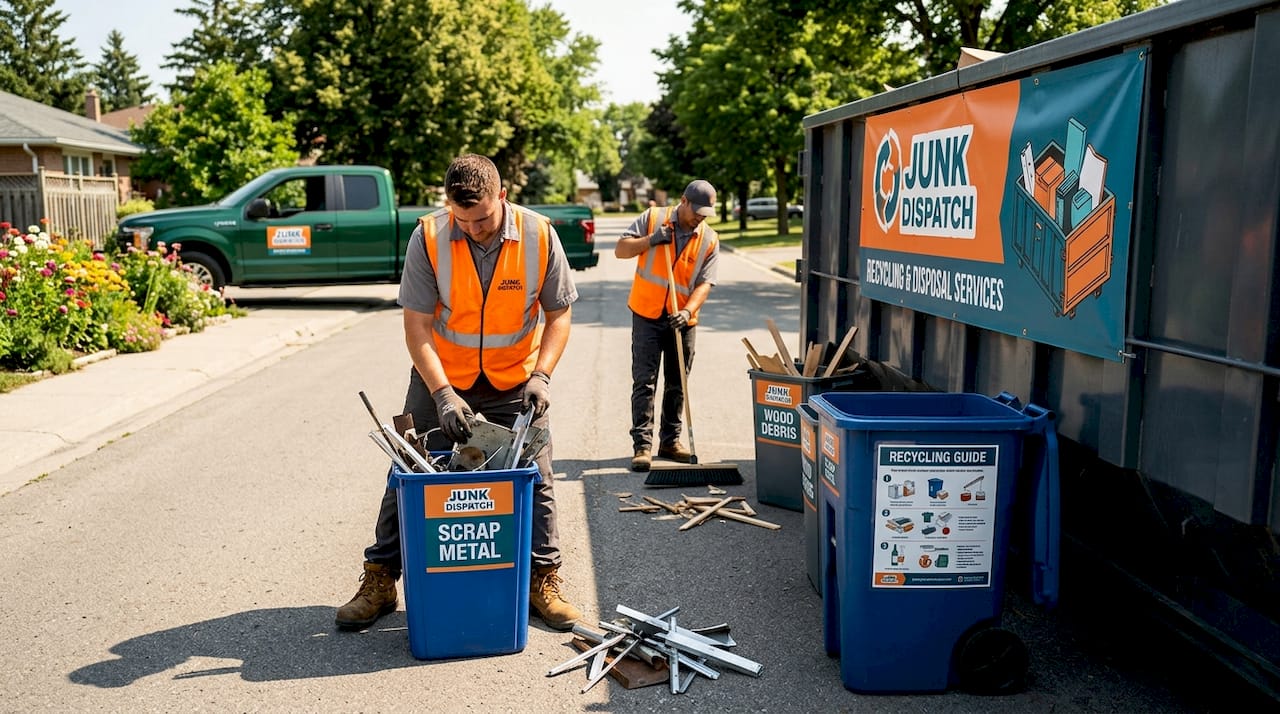
On the environmental side, recycling debris conserves natural resources by reducing demand for virgin materials like gravel, timber, and ore. It saves energy, since reprocessing existing materials consistently requires less energy than extracting and refining new ones. And it keeps enormous volumes of material out of landfills, which extends their lifespan and reduces methane emissions.
The economic case is equally strong:
Cost savings — tipping fees at landfills can be substantial, and diverting recyclable debris often costs less
Job creation — debris recycling integrates into circular economy models that build local processing capacity and employment
Material value — recovered metals, clean aggregate, and reclaimed wood all carry resale value that can offset project costs
On the regulatory front, standards are getting tighter. California’s CalGreen code raised the minimum C&D recycling rate from 50% to 65% in 2016, and similar pressure is building in Massachusetts and across the Northeast.
“Effective debris recycling aligns environmental goals with economic outcomes like resource efficiency, cost savings, and local job creation, making it a strategic sustainable practice.” — US EPA
That said, challenges exist. Contaminated or mixed debris dramatically lowers recovery rates and economic viability. Sorting requires labor and planning that many projects skip in the rush to clear a site. And some smaller municipalities lack the processing infrastructure to handle every debris type. The answer to most of these challenges is the same: better source separation from the start.
How to recycle debris effectively in Massachusetts
Recycling debris well is not accidental. It takes planning before a single tool swings. Here is how individuals and organizations in Massachusetts can get it right:
Assess your debris before the project starts. Walk through the scope and identify what materials will be generated. Concrete from a foundation demo is very different from a mixed renovation involving insulation, wiring, and flooring.
Set up separate containers for each material stream. A bin for clean concrete, one for wood, one for metal. Clear labeling prevents cross-contamination from subcontractors or laborers who are not focused on sorting.
Document as you go. Good debris waste management includes tracking what left the site, where it went, and whether it was recycled or landfilled. For commercial projects in Massachusetts, this documentation may be required.
Choose a hauler that prioritizes recycling. Not every junk removal company routes materials to recycling facilities. Ask specifically about their diversion practices. For tips on maximizing recycling on your next Massachusetts project, construction debris disposal tips lay out exactly what to look for.
Explore reuse before recycling. Clean bricks, dimensional lumber, and metal fixtures can often be donated or resold to salvage dealers. Reuse keeps materials in their highest-value form without the energy cost of processing.
Partner with a local professional service. Eco-friendly debris solutions describe how responsible local operators handle materials with recycling in mind from pickup through disposal.
Here is a side-by-side look at two common approaches:
Approach | Sorting required | Recycling rate | Cost impact |
Mixed load disposal | None at site | Low (often under 30%) | Higher tipping fees |
Source-separated disposal | Yes, by material type | High (50% to 80%+) | Lower net cost |
Pro Tip: Even partial separation pays off. Pulling metals out of a mixed load before pickup is often worth it on its own. Scrap metal has real market value, and recyclers often reduce fees for loads with clean metal separated out.
My take on debris recycling after years in this industry
I’ve watched debris pile up on job sites across Massachusetts and seen how differently crews handle it. Some separate carefully. Most don’t. And the difference in outcomes is significant, not just environmentally but financially.
What I’ve learned is that the biggest barrier to effective debris recycling isn’t technical. It’s the assumption that sorting is too slow or too complicated to be worth doing. That belief consistently costs people money. Clean concrete is cheap to recycle. Mixed garbage with concrete thrown in costs more to dispose of and recovers nothing.
The regulatory direction in the Northeast is clearly toward higher diversion requirements. Massachusetts project owners who get ahead of this now, building sorting into their standard project workflow, will save money and avoid compliance headaches later. I’ve also seen firsthand how recycling debris creates real downstream value. Local facilities process those materials. Local suppliers buy recycled aggregate. That cycle matters for communities here.
What I find most encouraging is the growing awareness among homeowners doing renovation work. People who call us have increasingly asked about where their debris ends up. That curiosity is worth acting on. The question isn’t whether debris recycling is worth doing. It’s whether you have the right process and partners in place to do it well.
— Joe
Let Junk Dispatch handle your debris the right way
When your Massachusetts project generates debris, the last thing you want is uncertainty about where it ends up. Junk Dispatch handles residential and commercial debris removal with a genuine commitment to responsible recycling and diversion from landfills.
Whether you’re a homeowner clearing renovation waste or a contractor managing a full demolition cleanout, Junk Dispatch provides insured crews, transparent pricing, and same-day service across Massachusetts. Our team knows how to handle construction debris, bulk materials, and mixed waste while routing as much as possible to certified recycling facilities. Serving clients across the region, including junk removal in Essex County and junk removal in Reading, we make eco-responsible debris removal genuinely easy. Get a free estimate and book online today.
FAQ
What is debris recycling in simple terms?
Debris recycling is the process of recovering materials from construction, demolition, or renovation projects and reprocessing them into usable products rather than sending them to a landfill. Common examples include crushing concrete into aggregate or chipping wood into mulch.
What types of debris can be recycled?
Concrete, brick, wood, metal, asphalt, drywall, and clean soil are all recyclable. Materials with hazardous contamination, such as asbestos or lead paint residue, require specialized handling and fall outside standard recycling streams.
How does the debris recycling process work?
The recycling process follows three core steps: collection and sorting at the source, processing at a facility through crushing, screening, and separation, and remanufacturing into new products like road base or reclaimed metal.
Why is source separation so important for debris recycling?
Mixed loads contaminate clean materials and lower recovery rates significantly. Clean mineral fractions are far easier and more economical to process, making on-site sorting the single most impactful step a homeowner or contractor can take.
What are the main benefits of debris recycling?
The key benefits of recycling C&D debris include conserving natural resources, reducing landfill use, lowering disposal costs, and creating local jobs in materials processing and recovery industries.
Recommended
Comments