Why regular office cleanouts boost productivity: 5 key benefits
- Joe Lusso
- 12 minutes ago
- 7 min read


TL;DR:
Regular office cleanouts improve productivity, reduce stress, and enhance employee morale.
Compliance with Massachusetts e-waste and data destruction laws is essential during cleanouts.
Implementing scheduled cleanouts as routine practices helps maintain a professional, efficient workspace.
Workers lose 2.5 hours every week just searching for misplaced items, and that number adds up fast across a team of ten, twenty, or fifty people. For Massachusetts business owners and facility managers, clutter is not a cosmetic problem. It is a measurable drag on output, a compliance risk, and a slow burn on employee morale. Regular office cleanouts are one of the most underrated tools available to keep your workplace sharp, legally protected, and genuinely pleasant to work in. This article walks you through exactly what is at stake, what the law requires, and how to build a cleanout routine that actually sticks.
Table of Contents
Key Takeaways
Point | Details |
Cleanouts boost productivity | Regular office cleanouts in Massachusetts can raise productivity by 15 percent while saving employees time each week. |
Compliance protects your business | Staying current with e-waste and confidential data disposal laws prevents state fines and security risks. |
Cleaner offices mean happier teams | Decluttering reduces stress, burnout, and boosts morale—making your workplace healthier and more attractive. |
Step-by-step process simplifies cleanouts | A planned routine with defined roles ensures every cleanout is thorough, compliant, and efficient. |
How clutter impacts productivity and morale
Most managers treat clutter as background noise. A pile of old monitors here, a cabinet stuffed with outdated files there. But the research tells a different story. Organized offices see 15% higher productivity compared to cluttered ones, and the effect is not subtle. When employees spend mental energy navigating disorder, they have less focus left for actual work.
The stress angle is just as significant. Clutter raises cortisol levels, the body’s primary stress hormone, and sustained exposure to a disorganized environment contributes directly to anxiety and burnout. Clean spaces, by contrast, lower cortisol and improve overall morale. That is not a soft benefit. That is the difference between a team that shows up energized and one that quietly disengages.
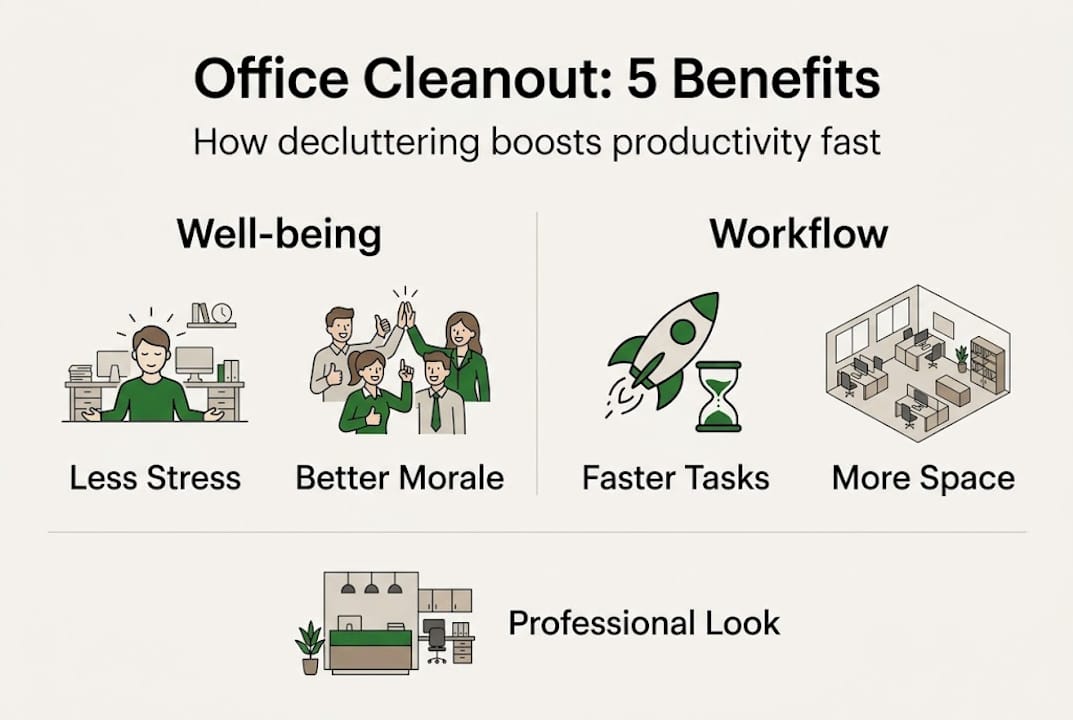
Here is a quick look at what clutter actually costs a typical Massachusetts office:
Factor | Cluttered office | Organized office |
Weekly time lost per employee | 2.5 hours | Near zero |
Productivity level | Baseline | Up to 15% higher |
Employee stress | Elevated cortisol | Reduced cortisol |
Client perception | Unprofessional | Confident and credible |
Common clutter sources in Massachusetts offices include:
Outdated desktop computers and monitors that nobody wants to deal with
Paper files from years past that were never digitized
Broken or surplus office furniture taking up floor space
Expired supplies and promotional materials stacked in corners
Unused kitchen appliances and personal items in common areas
“A cluttered workspace is not just an eyesore. It is a daily tax on every employee’s attention and energy.”
The good news is that an efficient workspace cleanup does not require a full office shutdown. Structured, recurring cleanouts prevent the pile-up from ever reaching crisis level.
Pro Tip: Schedule cleanouts on a fixed calendar, not just when things look bad. Consistent scheduling prevents the slow accumulation that drives stress and burnout over time.
Massachusetts laws: Compliance and risk in office cleanouts
Here is where many Massachusetts businesses get caught off guard. Cleanouts are not just about tidiness. They carry real legal weight, and ignoring that can cost you.
Massachusetts bans most electronics from landfills under M.G.L. c. 21H, and the state’s data privacy regulation, 201 CMR 17.00, requires businesses to securely destroy any personal information before disposal. That means old hard drives, laptops, and printed records with customer or employee data cannot simply go in the dumpster.
The penalties for non-compliance are real. Fines, regulatory scrutiny, and reputational damage are all on the table. More importantly, a data breach traced back to improperly discarded files can expose your business to civil liability.
Here is how compliance risks compare to the benefits of a proper cleanout process:
Risk without cleanouts | Benefit with proper cleanouts |
E-waste fines under M.G.L. c. 21H | Legal, documented electronics recycling |
Data breach from discarded files | Certified data destruction on record |
Regulatory audit exposure | Clear paper trail for inspectors |
Liability from improper disposal | Peace of mind and full compliance |
Common compliance mistakes Massachusetts offices make:
Throwing old computers and monitors in general trash or dumpsters
Shredding documents without a certified vendor and keeping no record
Assuming that deleting files from a hard drive counts as secure destruction
Mixing confidential paper records with regular recycling
A solid Massachusetts office cleanout guide will always include a compliance checklist. And reviewing office cleanout best practices before your next cleanout can help you avoid the most common legal traps.
Pro Tip: Keep a disposal log every time you remove electronics or sensitive documents. A simple spreadsheet with dates, item types, and vendor names is enough to protect you in an audit.
Regular cleanouts: Step-by-step for Massachusetts offices
Knowing you need a cleanout and actually running one are two different things. Here is a practical process that works for most Massachusetts offices, whether you have ten employees or two hundred.
Audit your space. Walk every area and document what is present: furniture, electronics, files, supplies. Take photos. This gives you a baseline and helps you prioritize.
Sort by category. Group items into keep, donate, recycle, and dispose. Electronics and sensitive documents get their own separate pile immediately.
Assign department leads. Each team owns their area. This distributes the workload and ensures nothing gets overlooked. Clear accountability speeds the whole process up.
Schedule professional removal. For bulk items, old electronics, and anything requiring certified disposal, bring in a licensed junk removal partner. This protects you legally and saves time.
Digitize what you can. Before shredding paper files, scan anything that may have future value. This reduces future clutter at the source.
Document everything. Record what was removed, how it was handled, and by whom. Keep this on file for at least three years.
If your office is in the middle of a move or renovation, that is the ideal time to run a deep cleanout. Integrating cleanouts during moves or renovations prevents old clutter from simply migrating to a new space, which is one of the most common and costly mistakes facilities teams make.
Useful resources for Massachusetts offices:
A detailed office cleanout checklist tailored to local regulations
Guidance on how to streamline office cleanouts when working with contractors
Pro Tip: Assign a single point of contact per department before the cleanout begins. When everyone knows their role, the process moves twice as fast and nothing falls through the cracks.
Signs your office needs a cleanout and what to expect
Sometimes the need for a cleanout is obvious. Other times it sneaks up on you. Here are the clearest signals that your office is overdue.
Visual and organizational red flags:
Storage rooms that are so packed nobody actually uses them
Old computers, monitors, or printers sitting on the floor or in hallways
Filing cabinets that cannot close because they are overfull
Common areas cluttered with personal items, old furniture, or unused equipment
Inventory you cannot locate because it is buried under other things
Behavioral and operational symptoms:
Employees complaining about not having enough space to work
Onboarding new staff is complicated because there is nowhere to put them
Meetings get derailed because materials cannot be found
Clients or visitors comment on the state of the office
What changes after a proper cleanout is often immediate and measurable. Teams report faster task completion, less frustration, and a stronger sense of pride in their workspace. The facility cleanout step-by-step guide from Junk Dispatch walks you through the full process if you want a structured approach.
“Clutter correlates directly to lower job satisfaction and higher stress, both of which affect your bottom line more than most business owners realize.”
The tangible benefits show up quickly: reclaimed floor space, faster workflows, a professional environment that impresses clients, and a team that feels respected enough to work in a clean space. These are not abstract gains. They show up in retention, output, and revenue.

Perspective: The hidden drivers of clutter and what really works
After working with Massachusetts businesses across industries, one pattern stands out clearly. Most offices only address clutter when it becomes a crisis. A lease renewal forces a cleanout. An inspection triggers a scramble. A new hire means suddenly realizing there is no desk available.
This reactive approach is expensive in ways that rarely get measured. The real cost is not the dumpster fee. It is the accumulated drag on productivity, the compliance exposure that builds quietly, and the slow erosion of workplace culture.
High-performing workplaces treat cleanouts the way they treat financial reviews: as a scheduled, recurring part of how the business operates. Quarterly cleanouts tied to business cycles, growth phases, or seasonal shifts become a habit rather than an event. That shift in mindset is what separates offices that stay sharp from those that constantly feel behind.
Understanding the commercial junk removal role in a broader facilities strategy helps businesses stop treating cleanouts as a one-time fix and start seeing them as infrastructure. Consistent habits, not occasional heroics, are what drive lasting results.
Streamline your cleanouts with help from Massachusetts experts
Regular office cleanouts protect your productivity, your compliance record, and your team’s well-being. But executing them well takes planning, the right resources, and sometimes professional support.

Junk Dispatch works with Massachusetts businesses of all sizes to handle office cleanouts efficiently, from single-room declutters to full facility removals. Whether you are in Reading or anywhere across Essex County, our insured crews handle e-waste, furniture, and sensitive material removal with full documentation. We offer same-day service, free estimates, and transparent pricing. Visit Junk Dispatch to book your assessment and get a custom cleanout plan built around your schedule and compliance needs.
Frequently asked questions
How often should offices schedule regular cleanouts?
Best practice is quarterly for most offices, with additional cleanouts triggered by moves, renovations, or significant staff changes.
What items must be recycled or specially handled in Massachusetts office cleanouts?
Electronics like computers and monitors and documents containing sensitive data must be handled separately, as MA bans most electronics from landfills and requires certified data destruction under 201 CMR 17.00.
What are the immediate benefits of a regular office cleanout?
You can expect productivity gains up to 15%, reduced employee stress, and a more professional environment for clients, with many improvements visible within days of completing the cleanout.
How can we ensure sensitive data is properly destroyed during a cleanout?
Contract with a certified data destruction vendor and retain documentation of every disposal event to demonstrate compliance with 201 CMR 17.00 during any regulatory audit.
Recommended
Comments